Back

Composition of Functions definitions

Control buttons has been changed to "navigation" mode.
1/15
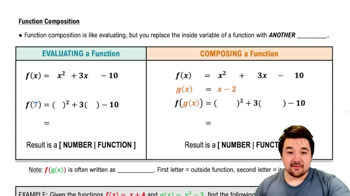
  • Function Composition

    Substituting one function into another, resulting in a new expression with combined operations and variables.
  • Composite Function

    A new function formed by inserting one function's output into another's input, often written as f(g(x)).
  • Notation

    Symbols like f(g(x)) or f∘g(x) used to represent the process of combining two functions.
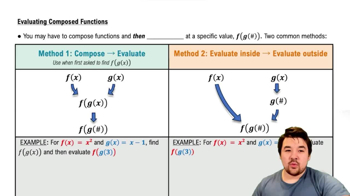
  • Inside Function

    The function placed within another, providing input for the outer function in a composition.
  • Outside Function

    The function that receives the output of another function as its input during composition.
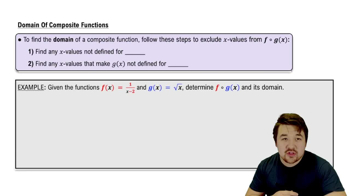
  • Domain

    The set of input values for which a function or composite function is defined, considering all restrictions.
  • Restriction

    A limitation on input values, such as avoiding negative radicands or zero denominators, affecting the domain.
  • Radicand

    The expression under a square root sign, which must be non-negative for real-valued functions.
  • Denominator

    The bottom part of a fraction, which must not equal zero to keep the function defined.
  • Polynomial

    An algebraic expression consisting of terms with variables raised to whole number powers and coefficients.
  • FOIL Method

    A technique for multiplying two binomials, expanding them into a polynomial by combining terms.
  • Binomial

    An algebraic expression with exactly two terms, often used in multiplication and simplification.
  • Simplification

    The process of reducing an expression to its most basic form by combining like terms and applying operations.
  • Evaluation

    Substituting specific values into a function or composite function to obtain a numerical result.
  • Square Root

    A mathematical operation that finds a value which, when multiplied by itself, gives the original number.