Beginning & Intermediate Algebra
My Course
Learn
AI Tutor
Study Guides
Flashcards
Explore
Try the app
My Course
Learn
AI Tutor
Study Guides
Flashcards
Explore
Try the app
Back
Composition of Functions quiz
You can tap to flip the card.
What does function composition involve?
You can tap to flip the card.
👆
What does function composition involve?
Function composition involves substituting one function into another, such as f(g(x)), to create a new expression or function.
Track progress
Control buttons has been changed to "navigation" mode.
1/15
Related flashcards
Recommended videos
Composition of Functions definitions
Composition of Functions
15 Terms
3:51
Domain Restrictions of Composed Functions
61
views
4:26
Evaluating Composed Functions
62
views
1
rank
4:56
Function Compositions
75
views
Terms in this set (15)
Hide definitions
What does function composition involve?
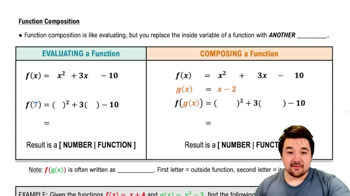
Function composition involves substituting one function into another, such as f(g(x)), to create a new expression or function.
How do you evaluate f(7) for f(x) = x^2 + 3x - 10?
Replace all x's with 7, calculate 7^2 + 3*7 - 10, which equals 60.
What is the result of composing f(x) = x^2 + 3x - 10 with g(x) = x - 2 to find f(g(x))?
Replace x in f(x) with g(x), giving (x - 2)^2 + 3(x - 2) - 10, which simplifies to x^2 - x - 12.
How is the notation f ∘ g(x) interpreted?
It means f(g(x)), where g(x) is the inside function and f(x) is the outside function.
What is f(g(x)) for f(x) = x + 4 and g(x) = x^2 - 3?
Replace x in f(x) with g(x), resulting in x^2 - 3 + 4, which simplifies to x^2 + 1.
How do you find g(f(x)) for f(x) = x + 4 and g(x) = x^2 - 3?
Replace x in g(x) with f(x), giving (x + 4)^2 - 3, which simplifies to x^2 + 8x + 13.
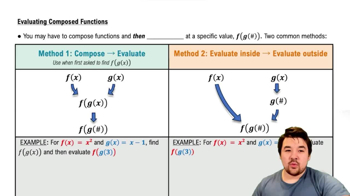
What is the first step in evaluating a composed function at a number?
Compose the functions to get a new function, then substitute the number into the composed function.
How do you use the shortcut method to evaluate f(g(3)) for f(x) = x^2 and g(x) = x - 1?
First, evaluate g(3) = 2, then substitute 2 into f(x), so f(2) = 4.
Why can't the shortcut method always be used for evaluating composed functions?
Because sometimes you are required to find the composed function f(g(x)) before substituting a value.
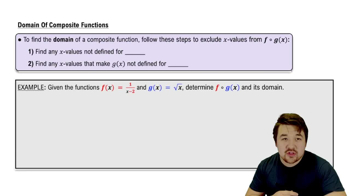
What is the domain restriction for g(x) = sqrt(x)?
x must be greater than or equal to 0, since the radicand cannot be negative.
What additional domain restriction arises when composing f(x) = 1/(x - 2) with g(x) = sqrt(x)?
The denominator sqrt(x) - 2 cannot be zero, so sqrt(x) ≠ 2, which means x ≠ 4.
How do you combine domain restrictions for composed functions?
Find restrictions for the inside function, then for the composed function, and combine them to get the total domain.
What is the domain of f(g(x)) for f(x) = 1/(x - 2) and g(x) = sqrt(x)?
The domain is x ≥ 0, x ≠ 4; in interval notation, [0, 4) ∪ (4, ∞).
What is the FOIL method used for in function composition?
The FOIL method is used to expand binomials when simplifying composed functions, such as (x + 4)^2.
When composing functions, which function is considered the 'inside' function?
The function written second in the composition, such as g in f(g(x)), is the inside function.