Beginning & Intermediate Algebra
My Course
Learn
AI Tutor
Study Guides
Flashcards
Explore
Try the app
My Course
Learn
AI Tutor
Study Guides
Flashcards
Explore
Try the app
Back
Evaluating Exponents quiz
You can tap to flip the card.
What does exponent notation represent in mathematics?
You can tap to flip the card.
👆
What does exponent notation represent in mathematics?
Exponent notation represents repeated multiplication of a base number by itself a certain number of times.
Track progress
Control buttons has been changed to "navigation" mode.
1/15
Related flashcards
Recommended videos
Evaluating Exponents definitions
Evaluating Exponents
15 Terms
01:55
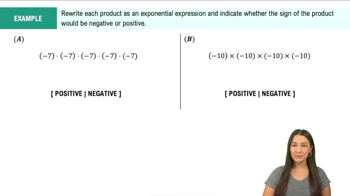
Exponential Expressions with Negative Bases Example 4
102
views
17
rank
00:51
Intro to Exponents Example 2
232
views
12
rank
05:24
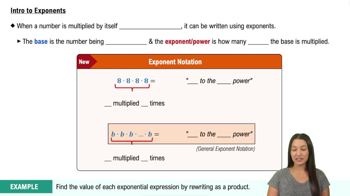
Intro to Exponents
439
views
17
rank
Terms in this set (15)
Hide definitions
What does exponent notation represent in mathematics?
Exponent notation represents repeated multiplication of a base number by itself a certain number of times.
In the expression 8^4, what is the base and what is the exponent?
The base is 8 and the exponent is 4.
How would you verbally read the expression 8^4?
You would read it as 'eight to the fourth power.'
What does the expression 7^2 mean and what is its value?
It means 7 multiplied by itself (7 × 7), which equals 49.
What is the special term for an exponent of 2?
An exponent of 2 is called 'squared.'
How do you expand 10^3 as a product and what is its value?
10^3 expands to 10 × 10 × 10, which equals 1,000.
What is the special term for an exponent of 3?
An exponent of 3 is called 'cubed.'
How do you evaluate 2^5 and what is the result?
Multiply 2 by itself five times (2 × 2 × 2 × 2 × 2), which equals 32.
What does it mean if a number is written without an exponent?
It means the number has an implied exponent of 1.
How do you evaluate (-2)^4 and what is the result?
Multiply -2 by itself four times; the result is positive 16.
What is the value of (-3)^3 and why?
(-3)^3 equals -27 because multiplying three negative numbers results in a negative value.
What happens when a negative number is raised to an even power?
The result is positive because the negatives pair off to make positives.
What happens when a negative number is raised to an odd power?
The result is negative because there is one unpaired negative factor.
What is the value of -5^2 and why is it different from (-5)^2?
-5^2 equals -25 because it means negative one times 5 squared, not negative five squared.
Why is it important to pay attention to parentheses in exponential expressions with negatives?
Parentheses determine whether the negative is part of the base or just a factor, which affects the sign of the result.