Back

Exponential Functions definitions

Control buttons has been changed to "navigation" mode.
1/15
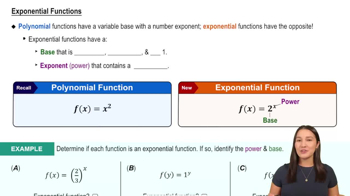
  • Exponential Function

    A mathematical relationship where a constant positive number is raised to a variable power, producing rapid growth or decay.
  • Base

    A fixed positive number, not equal to one, that is repeatedly multiplied in an exponential expression.
  • Exponent

    A variable or expression indicating how many times the base is used as a factor in an exponential function.
  • Power

    The value or expression to which the base is raised, often containing a variable in exponential functions.
  • Polynomial Function

    A mathematical expression with variables as bases and fixed exponents, differing from exponential functions.
  • Fractional Base

    A constant positive fraction used as the base in an exponential function, provided it is not equal to one.
  • Negative Exponent

    An exponent less than zero, resulting in the reciprocal of the base raised to the positive value of the exponent.
  • Reciprocal

    A value obtained by dividing one by a given number, often used when handling negative exponents.
  • Caret Key

    A calculator symbol (^) used to indicate exponentiation, allowing entry of bases and powers.
  • Growth

    A pattern in exponential functions where values increase rapidly as the exponent rises.
  • Decay

    A pattern in exponential functions where values decrease quickly as the exponent becomes more negative.
  • Constant

    A fixed value that does not change, required for the base in exponential functions.
  • Variable

    A symbol representing a value that can change, commonly found in the exponent of exponential functions.
  • Calculator

    A tool used to compute exponential values, especially for non-integer or large exponents.
  • Expression

    A combination of numbers, variables, and operations forming a mathematical statement, such as those in exponential functions.