Skip to main content
Beginning & Intermediate Algebra
My Course
Learn
Exam Prep
AI Tutor
Study Guides
Flashcards
Explore
Try the app
My Course
Learn
Exam Prep
AI Tutor
Study Guides
Flashcards
Explore
Try the app
Back
Introduction to Sequences quiz
You can tap to flip the card.
What is the domain of a sequence?
You can tap to flip the card.
👆
What is the domain of a sequence?
The domain of a sequence is all positive integers, starting from 1 and increasing by 1 each time.
Track progress
Control buttons has been changed to "navigation" mode.
1/15
Related flashcards
Related practice
Recommended videos
Introduction to Sequences definitions
Introduction to Sequences
15 Terms
Introduction to Sequences
15. Sequences, Series, and the Binomial Theorem
5 problems
Topic
AllySteele
Arithmetic Sequences
15. Sequences, Series, and the Binomial Theorem
5 problems
Topic
ZacharyFrye
15. Sequences, Series, and the Binomial Theorem
4 topics
12 problems
Chapter
ErnestBlazevic
5:52
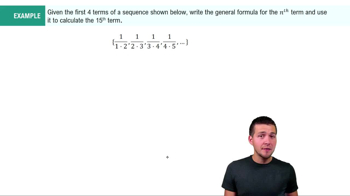
Writing a General Formula Example 5
79
views
01:43
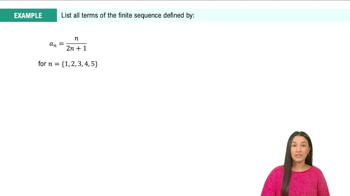
Intro to Sequences Example 3
86
views
7:17
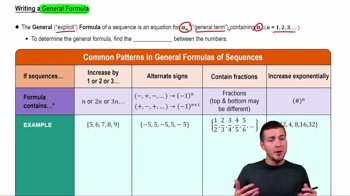
Writing a General Formula
101
views
Terms in this set (15)
Hide definitions
What is the domain of a sequence?
The domain of a sequence is all positive integers, starting from 1 and increasing by 1 each time.
How do you find the nth term of a sequence given its general term?
You substitute the index n into the general term formula to calculate the nth term.
What is the notation used for the nth term of a sequence?
The nth term is denoted as a sub n, written as a_n.
How do you determine if a sequence is finite or infinite?
A sequence is finite if the index n is restricted to a certain maximum value; otherwise, it is infinite.
What is the first term of the sequence with general term a_n = 2^n?
The first term is 2, found by plugging n = 1 into the formula.
How do you write the explicit formula for a sequence that increases by a constant amount each time?
The explicit formula will include n multiplied by the constant difference, possibly adjusted by adding or subtracting a constant.
What pattern in a sequence suggests using (-1)^n in the formula?
A sequence that alternates signs, such as negative, positive, negative, positive, suggests using (-1)^n.
How do you adjust a formula if the first term does not match the index value?
You add or subtract a constant to the formula so that plugging in n = 1 gives the correct first term.
What is the general formula for the sequence 1/2, 2/3, 3/4, 4/5, 5/6?
The general formula is a_n = n/(n+1).
How do you recognize an exponential sequence?
An exponential sequence has terms that are powers of a base, such as 2, 4, 8, 16, which are all powers of 2.
What is the explicit formula for the sequence 5, 6, 7, 8, 9?
The explicit formula is a_n = n + 4.
How do you find all terms of a finite sequence defined by a_n = 4 - n for 1 ≤ n ≤ 6?
Plug in n = 1 through n = 6 into the formula to get all terms: 3, 2, 1, 0, -1, -2.
What does the notation a_10 represent in a sequence?
a_10 represents the 10th term of the sequence, found by plugging n = 10 into the general term.
Why might you need to multiply by a constant in a sequence formula with alternating signs?
Multiplying by a constant adjusts the magnitude of the terms to match the sequence values.
What is an explicit formula in the context of sequences?
An explicit formula is an equation involving n that allows you to find any term in the sequence directly.
 BackBack


 5:52
5:52