Beginning & Intermediate Algebra
My Course
Learn
AI Tutor
Study Guides
Flashcards
Explore
Try the app
My Course
Learn
AI Tutor
Study Guides
Flashcards
Explore
Try the app
Back
Multiplying, Dividing, and Rationalizing Radicals quiz
You can tap to flip the card.
What does it mean to rationalize the denominator?
You can tap to flip the card.
👆
What does it mean to rationalize the denominator?
It means to eliminate any radicals from the denominator of a fraction so that the denominator is a rational number.
Track progress
Control buttons has been changed to "navigation" mode.
1/15
Related flashcards
Recommended videos
Multiplying, Dividing, and Rationalizing Radicals definitions
Multiplying, Dividing, and Rationalizing Radicals
15 Terms
02:34
Rationalizing Denominators Example 3
58
views
Guided course
02:58
Rationalizing Denominators
75
views
1
rank
Guided course
05:00
Multiplication of Radical Expressions Example 2
20
views
Terms in this set (15)
Hide definitions
What does it mean to rationalize the denominator?
It means to eliminate any radicals from the denominator of a fraction so that the denominator is a rational number.
Why can't you leave a radical in the denominator of a fraction?
Because in standard mathematical form, denominators should be rational, not irrational or containing radicals.
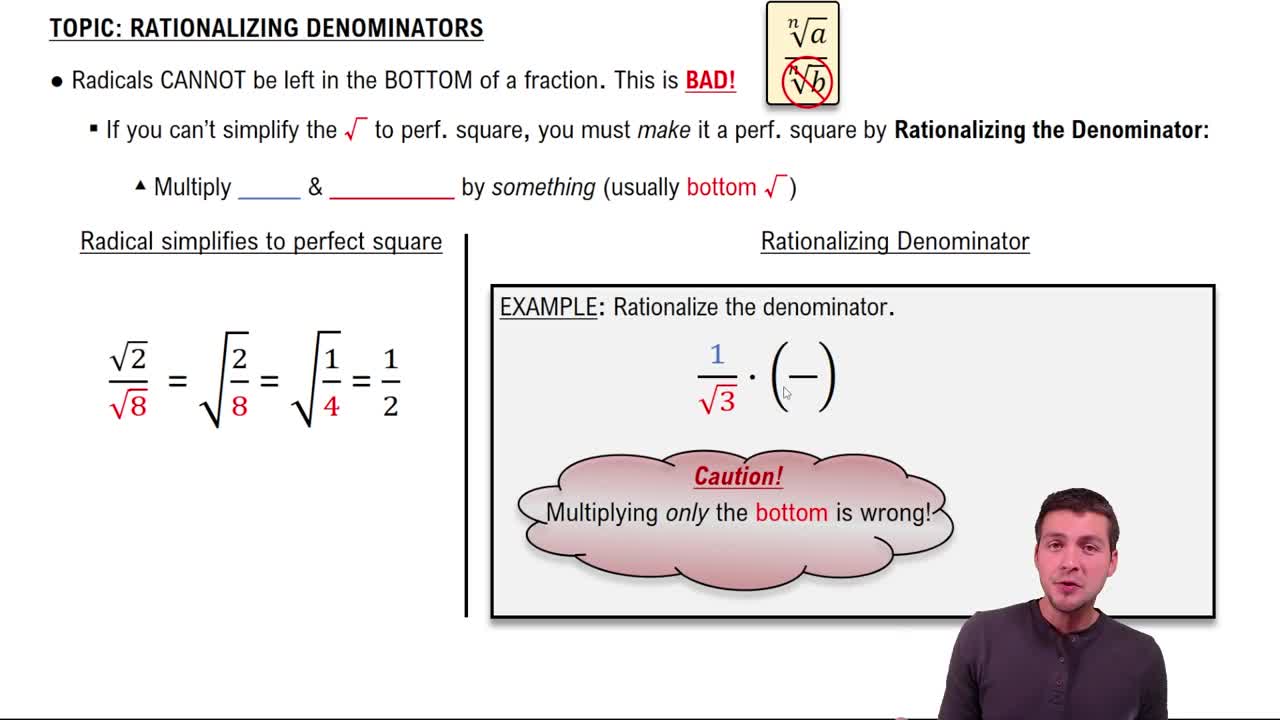
What do you multiply by to rationalize a denominator with a single radical term, like 1/√3?
You multiply both the numerator and denominator by the same radical, in this case √3.
What is the result of multiplying √3 by √3?
The result is 3, because √3 × √3 = √9 = 3.
After rationalizing 1/√3, what is the equivalent expression?
The equivalent expression is √3/3.
What is a conjugate in the naturally occurring context of rationalizing denominators?
A conjugate is formed by changing the sign between two terms in a binomial, such as turning 2 + √3 into 2 - √3.
Why do you use the conjugate to rationalize denominators with two terms, like 1/(2+√3)?
Because multiplying by the conjugate creates a difference of squares, which eliminates the radical in the denominator.
What is the general formula for the conjugate of a + √b?
The conjugate is a - √b.
What happens when you multiply (2+√3) by its conjugate (2-√3)?
You get a difference of squares: (2)^2 - (√3)^2 = 4 - 3 = 1.
When rationalizing 1/(2+√3), what do you multiply the numerator and denominator by?
You multiply both by the conjugate, which is (2-√3).
What is the simplified result of rationalizing 1/(2+√3)?
The result is (2-√3)/1, which simplifies to 2-√3.
Why does multiplying by the conjugate always eliminate the radical in the denominator?
Because it uses the difference of squares, which cancels out the radical terms.
What must you always do to both the numerator and denominator when rationalizing?
You must multiply both by the same value to keep the expression equivalent.
Is it acceptable to have a radical in the numerator after rationalizing?
Yes, having a radical in the numerator is acceptable; only the denominator must be rational.
What are the two main cases for rationalizing denominators?
If the denominator is a single term, multiply by the radical; if it's two terms, multiply by the conjugate.