Back

Simplifying Radical Expressions quiz

Control buttons has been changed to "navigation" mode.
1/15
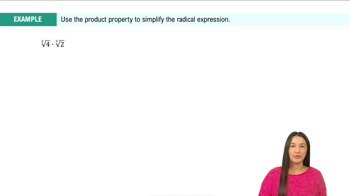
  • What does the product rule for radicals state?

    The product rule states that the square root of a times the square root of b equals the square root of a times b, or √a × √b = √(a × b).
  • How can you use the product rule to condense two radicals into one?

    Multiply the numbers under the radicals and place the product under a single radical sign.
  • How can you use the product rule in reverse to expand a single radical?

    Rewrite the number under the radical as a product and split it into two separate radicals.
  • What is the simplified form of √3 × √11 using the product rule?

    The simplified form is √33.
  • How do you simplify √2 × √8 using the product rule?

    First, combine under one radical to get √16, then simplify to 4.
  • How do you simplify √50 using the product rule?

    Rewrite 50 as 25 × 2, then expand to √25 × √2, which simplifies to 5√2.
  • When can a radical not be simplified further using the product rule?

    When the number under the radical cannot be factored into a product that includes a perfect square.
  • Does the product rule apply only to square roots?

    No, it applies to any radicals of the same index, such as cube roots or fourth roots.
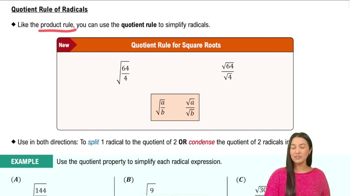
  • What does the quotient rule for radicals state?

    The quotient rule states that the square root of a divided by b equals the square root of a divided by the square root of b, or √(a/b) = √a / √b.
  • How can you use the quotient rule to split a single radical into two?

    Rewrite the radical as the quotient of two separate radicals, one for the numerator and one for the denominator.
  • How do you use the quotient rule in reverse to condense two radicals into one?

    Combine the division under a single radical sign.
  • What is the simplified form of √144/25 using the quotient rule?

    It simplifies to 12/5.
  • How do you simplify √9/49 using the quotient rule?

    Split into √9 / √49, which simplifies to 3/7.
  • How do you simplify (√300)/(√3) using the quotient rule?

    Combine under one radical to get √(300/3) = √100, which simplifies to 10.
  • Does the quotient rule apply only to square roots?

    No, it applies to any radicals of the same index, such as nth roots.