Back

Slope-Intercept Form definitions

Control buttons has been changed to "navigation" mode.
1/15
  • Slope-Intercept Form

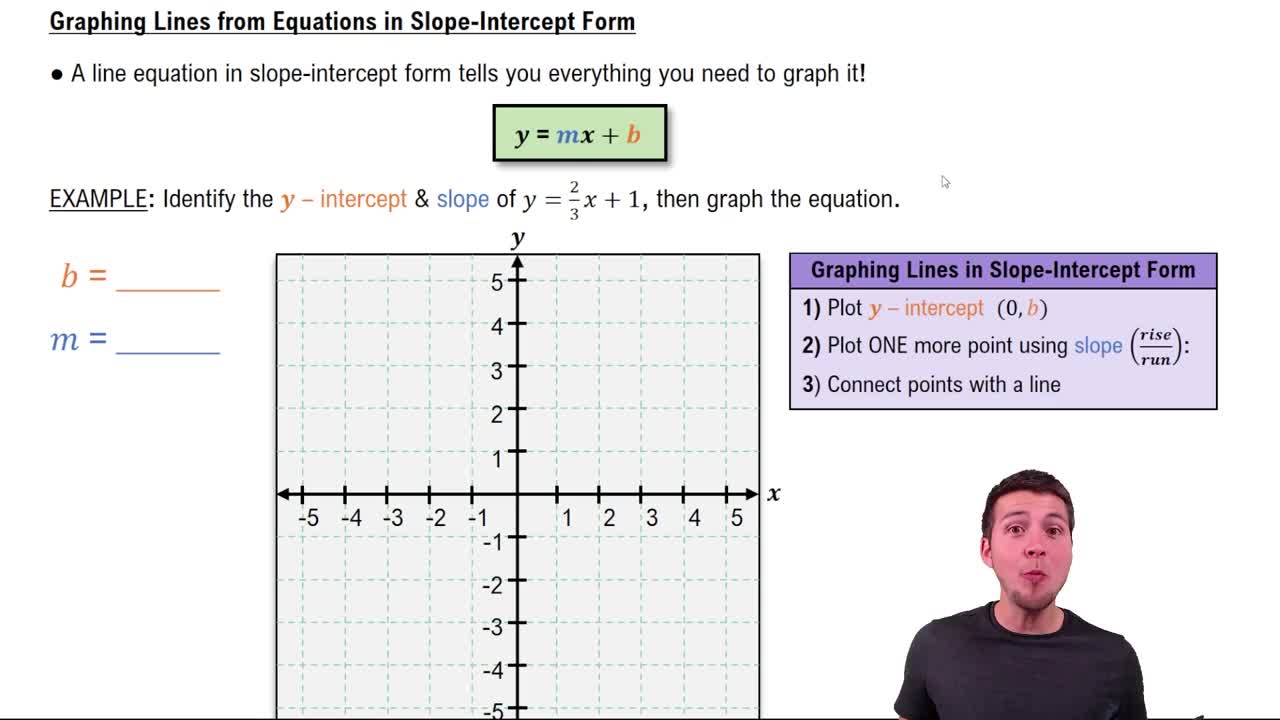
    An equation format for lines using slope and y-intercept, written as y equals mx plus b.
  • Slope

    A measure of a line's steepness, calculated as rise over run or delta y over delta x.
  • Y-Intercept

    The y value where a line crosses the y-axis, represented by the b term in the equation.
  • Point-Slope Form

    A line equation format using a slope and a specific point, written as y minus y1 equals m times x minus x1.
  • Parallel Lines

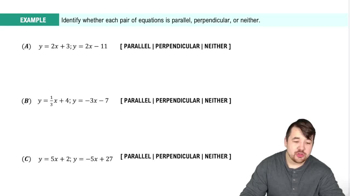
    Lines that never intersect and have identical slopes but different y-intercepts.
  • Perpendicular Lines

    Lines that intersect at a 90-degree angle and have slopes that are negative reciprocals.
  • Reciprocal

    A value obtained by flipping a fraction, used to relate slopes of perpendicular lines.
  • Negative Reciprocal

    A fraction's reciprocal with its sign changed, crucial for identifying perpendicular slopes.
  • Graph

    A visual representation of equations, showing lines, points, and intersections on axes.
  • Coordinate

    A pair of values indicating a point's position on a graph, typically written as x comma y.
  • Ordered Pair

    A set of two numbers representing a point's location, with the first for x and second for y.
  • Delta Y

    The change in y values between two points, used in calculating slope.
  • Delta X

    The change in x values between two points, used in calculating slope.
  • Intercept

    A point where a line crosses an axis, most commonly the y-axis in linear equations.
  • Equation

    A mathematical statement showing the relationship between variables, often used to describe lines.