Skip to main content
Beginning & Intermediate Algebra
My Course
Learn
Exam Prep
AI Tutor
Study Guides
Flashcards
Explore
Try the app
My Course
Learn
Exam Prep
AI Tutor
Study Guides
Flashcards
Explore
Try the app
Back
Solving Linear Equations definitions
You can tap to flip the card.
Linear Equation
You can tap to flip the card.
👆
Linear Equation
An algebraic statement where the variable's highest power is one and both sides are equal.
Track progress
Control buttons has been changed to "navigation" mode.
1/15
Related flashcards
Related practice
Recommended videos
Solving Linear Equations quiz
Solving Linear Equations
15 Terms
Solving Linear Equations
2. Linear Equations and Inequalities
5 problems
Topic
JustinRaimundo
Linear Inequalities in One Variable
2. Linear Equations and Inequalities
5 problems
Topic
JustinRaimundo
2. Linear Equations and Inequalities
4 topics
12 problems
Chapter
ErnestBlazevic
06:21
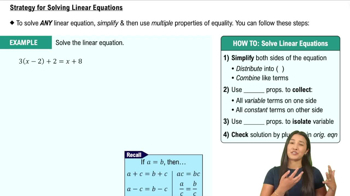
Strategy for Solving Linear Equations
287
views
6
rank
Guided course
06:25
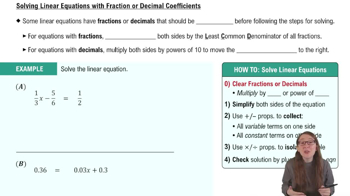
Solving Linear Equations with Fraction or Decimal Coefficients
204
views
6
rank
Guided course
05:27
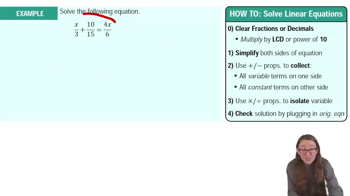
Solving Linear Equations with Fraction or Decimal Coefficients Example 2
146
views
Terms in this set (15)
Hide definitions
Linear Equation
An algebraic statement where the variable's highest power is one and both sides are equal.
Variable
A symbol representing an unknown value that can be solved for in an equation.
Coefficient
A numerical factor multiplied by a variable in an algebraic expression.
Constant
A fixed value in an equation that does not change with the variable.
Distribution
The process of multiplying a value across terms inside parentheses.
Like Terms
Terms in an expression that have identical variable parts and can be combined.
Property of Equality
A rule allowing the same operation on both sides of an equation to maintain balance.
Addition Property of Equality
A principle stating that adding the same value to both sides keeps the equation true.
Subtraction Property of Equality
A principle stating that subtracting the same value from both sides keeps the equation true.
Multiplication Property of Equality
A principle stating that multiplying both sides by the same value preserves equality.
Division Property of Equality
A principle stating that dividing both sides by the same nonzero value preserves equality.
Least Common Denominator
The smallest shared multiple of denominators used to clear fractions in equations.
Identity
An equation true for all values of the variable, resulting in infinite solutions.
Conditional Equation
An equation true only for a specific value of the variable, yielding a single solution.
Contradiction
An equation that is never true, resulting in no possible solutions.
 BackBack

 06:21
06:21