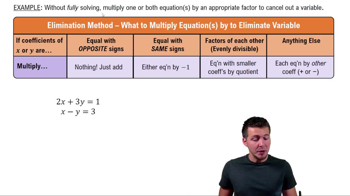
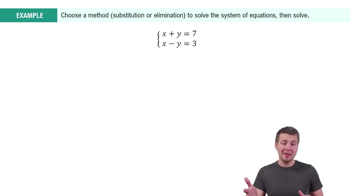
What is the main goal of the elimination method when solving systems of linear equations?
The main goal is to add or subtract equations to eliminate one variable, making the system easier to solve.
Why must equations be written in standard form before using the elimination method?
Equations must be in standard form so that like terms (x, y, constants) are aligned vertically for easy addition or subtraction.
What should you do if the coefficients of a variable are already equal and opposite in two equations?
You can add the equations directly, and the variable will be eliminated.
If the coefficients of a variable are equal but have the same sign, what is the first step you should take?
Multiply one of the equations by -1 to make the coefficients equal and opposite.
How do you decide what number to multiply an equation by to eliminate a variable?
Multiply by a number that makes the coefficients of the variable equal in magnitude but opposite in sign.
What is the next step after eliminating one variable using the elimination method?
Solve for the remaining variable, then substitute its value back into one of the original equations to find the other variable.
When is it more efficient to use the elimination method instead of substitution?
It's more efficient when both equations are in standard form and the coefficients are easily manipulated to cancel a variable.
What should you do if neither variable's coefficients are equal, opposite, or factors of each other?
Multiply each equation by the other equation's variable coefficient (possibly with a negative sign) to create equal and opposite coefficients.
What does it mean for coefficients to be 'factors of each other' in the context of elimination?
It means one coefficient can be multiplied by an integer to become the other coefficient.
Why might you avoid using substitution if the equations are not already isolated for a variable?
Because isolating a variable could introduce complex fractions, making the process more difficult.
What is the advantage of aligning equations vertically in elimination?
It allows you to add or subtract corresponding terms directly, simplifying the process of eliminating a variable.
If you have 3x + 2y = 1 and -x + y = 3, what must you do before adding the equations to eliminate x?
Multiply the second equation by 3 to make the x coefficients equal and opposite.
After finding the value of one variable in elimination, how do you find the other variable?
Substitute the known value into either original equation and solve for the remaining variable.
What is a quick check you can do after solving a system by elimination?
Plug both variable values into the original equations to verify that both equations are satisfied.
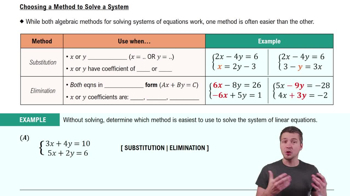
What are the two main algebraic methods for solving systems of equations, and when is elimination preferred?
The two methods are substitution and elimination; elimination is preferred when equations are in standard form and coefficients can be easily manipulated.
 Back
Back

 06:26
06:26