Back

The Quotient Rule definitions

Control buttons has been changed to "navigation" mode.
1/14
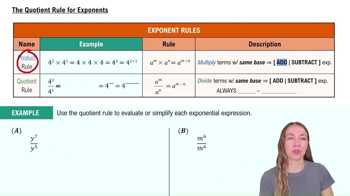
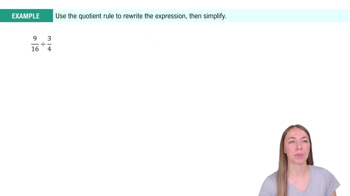
  • Quotient Rule

    A method for simplifying division of exponential terms with identical bases by subtracting the exponents.
  • Exponent

    A value indicating how many times a base is multiplied by itself in an exponential expression.
  • Base

    The repeated factor in an exponential expression, remaining constant when applying exponent rules.
  • Dividend

    The numerator in a division problem, representing the quantity being divided.
  • Divisor

    The denominator in a division problem, representing the quantity dividing the dividend.
  • Zero Exponent Rule

    A principle stating that any nonzero base raised to the zero power equals one.
  • Numerator

    The top part of a fraction, indicating the number of parts being considered.
  • Denominator

    The bottom part of a fraction, indicating the total number of equal parts.
  • Simplification

    The process of reducing an expression to its most basic form using mathematical rules.
  • Polynomial

    An algebraic expression consisting of variables and exponents combined using addition, subtraction, and multiplication.
  • Product Rule

    A method for simplifying multiplication of exponential terms with identical bases by adding the exponents.
  • Same Base

    A condition where exponential expressions share an identical repeated factor, allowing exponent rules to be applied.
  • Expression

    A combination of numbers, variables, and operations representing a mathematical value.
  • Power

    A mathematical notation indicating a base raised to an exponent, showing repeated multiplication.