Back

The Quotient Rule quiz

Control buttons has been changed to "navigation" mode.
1/15
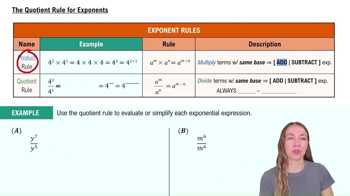
  • What does the quotient rule for exponents state when dividing terms with the same base?

    Subtract the exponent of the divisor from the exponent of the dividend: am/an = am-n.
  • How do you simplify 4^3 divided by 4^1 using the quotient rule?

    Subtract the exponents: 3 - 1 = 2, so 4^3/4^1 = 4^2.
  • What is the result of y^7 divided by y^5?

    y^7/y^5 = y^(7-5) = y^2.
  • What do you do with the exponents when dividing exponential expressions with the same base?

    You subtract the exponent in the denominator from the exponent in the numerator.
  • What is the simplified form of m^6 divided by m^6?

    m^6/m^6 = m^(6-6) = m^0.
  • What does any nonzero number raised to the zero power equal?

    Any nonzero number to the zero power equals one.
  • Why does m^0 equal 1?

    Because m^6/m^6 = 1, and by the quotient rule, this is m^0, so m^0 = 1.
  • What is the zero exponent rule?

    Any nonzero base raised to the zero power equals one.
  • How can you remember whether to add or subtract exponents when multiplying or dividing?

    When multiplying, add exponents; when dividing, subtract exponents.
  • What is the simplified form of a^5 divided by a^2?

    a^5/a^2 = a^(5-2) = a^3.
  • If you have x^n/x^n, what does this simplify to?

    x^n/x^n = x^(n-n) = x^0 = 1, as long as x ≠ 0.
  • What must be true about the bases to use the quotient rule?

    The bases must be the same.
  • What is the result of 7^4 divided by 7^2?

    7^4/7^2 = 7^(4-2) = 7^2.
  • What happens to the exponents when you expand and cancel matching factors in numerator and denominator?

    Each matching factor cancels, reducing the exponent by one for each pair.
  • What is the simplified form of b^8 divided by b^3?

    b^8/b^3 = b^(8-3) = b^5.