Back

Translating Sentences to Equations definitions

Control buttons has been changed to "navigation" mode.
1/15
  • Equation

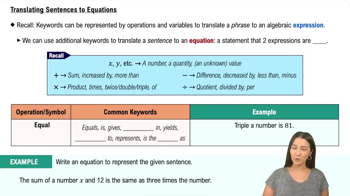
    A mathematical statement showing two expressions are equal, often formed by translating sentences using keywords.
  • Expression

    A combination of numbers, variables, and operations that represents a value but does not include an equal sign.
  • Variable

    A symbol, often a letter, used to represent an unknown value in mathematical phrases or equations.
  • Sum

    A keyword indicating addition, used to combine two or more values or variables in an algebraic context.
  • Difference

    A term signaling subtraction, used to find how much one value exceeds or falls short of another.
  • Product

    A term representing multiplication, often used when phrases like 'times' or 'triple' appear in sentences.
  • Quotient

    A term indicating division, used when phrases like 'divided by' are present in mathematical sentences.
  • Equal Sign

    A symbol with two parallel lines, used to show that two expressions have the same value in an equation.
  • Keyword

    A word or phrase in a sentence that signals which mathematical operation or symbol to use when translating.
  • Operation

    A mathematical process such as addition, subtraction, multiplication, or division, indicated by specific keywords.
  • Translation

    The process of converting a written sentence or phrase into an algebraic equation using recognized keywords.
  • Coefficient

    A numerical factor multiplied by a variable, often appearing in phrases like 'triple a number.'
  • Phrase

    A group of words in a sentence that can be converted into an algebraic expression or equation.
  • Polynomials

    Expressions consisting of variables and coefficients, combined using addition, subtraction, and multiplication.
  • Value

    A quantity or number represented by a variable or directly stated in a mathematical sentence.