 Back
BackAlgebra I Review: Real Numbers, Equations, and Graphing
Study Guide - Smart Notes
 Tailored notes based on your materials, expanded with key definitions, examples, and context.
Chapter 1 – Real Numbers and Variables
Evaluating Algebraic Expressions
Evaluating algebraic expressions involves substituting given values for variables and performing the indicated operations. This is a foundational skill in algebra, necessary for solving equations and modeling real-world problems.
Key Point 1: Substitute the given value(s) for each variable in the expression.
Key Point 2: Follow the order of operations (PEMDAS/BODMAS) to simplify the expression.
Example: Evaluate for :
Substitute:
Calculate:
Removing Grouping Symbols and Combining Like Terms
Expressions often contain parentheses or brackets, which must be removed using the distributive property. Like terms (terms with the same variable and exponent) can be combined to simplify expressions.
Distributive Property:
Combining Like Terms: Add or subtract coefficients of terms with the same variable and exponent.
Example: Simplify :
Distribute:
Combine like terms:
Chapter 2 – Equations, Inequalities, and Applications
Solving Linear Equations
Linear equations can have variables on both sides, parentheses, or fractions. The goal is to isolate the variable on one side of the equation.
Key Steps:
Use the distributive property to remove parentheses.
Combine like terms on each side.
Add or subtract terms to get all variables on one side and constants on the other.
Divide or multiply to solve for the variable.
Example: Solve :
Add to both sides:
Subtract $14
Divide by $3x = -1$
Translating English Phrases into Algebraic Expressions
Many word problems require translating phrases into algebraic expressions or equations.
"Twelve less than a number":
"Five more than one-third of a number":
"One-third of a number reduced by twice the same number":
"Four less than seven times a number":
Solving Proportion Equations
Proportions are equations that state two ratios are equal. They can be solved by cross-multiplying.
General Form:
Cross-multiplication:
Example: → →
Solving and Graphing Inequalities
Inequalities are solved similarly to equations, but the solution is often a range of values. When multiplying or dividing both sides by a negative number, reverse the inequality sign.
Example: Solve :
Subtract :
Simplify:
Subtract $2-3x > -9$
Divide by (reverse sign):
Chapter 3 – Graphing and Functions
Plotting Points and Reading Coordinates
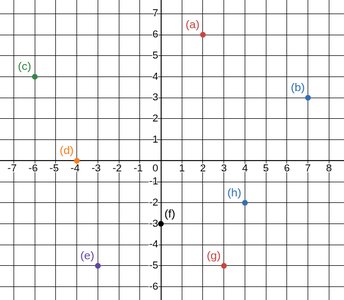
Points in the coordinate plane are represented as ordered pairs . The first value is the horizontal (x) coordinate, and the second is the vertical (y) coordinate.
To plot a point: Move along the x-axis to the x-value, then move vertically to the y-value.
To read a point: Identify the x and y values from the graph.
Finding Ordered Pairs for Linear Equations
To find ordered pairs that satisfy a linear equation, substitute values for x (or y) and solve for the other variable.
Example: For , if , then , so the ordered pair is .
Graphing Linear Equations
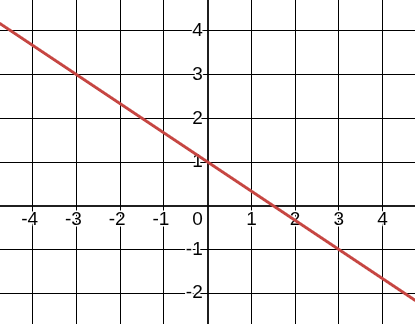
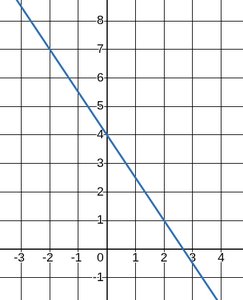
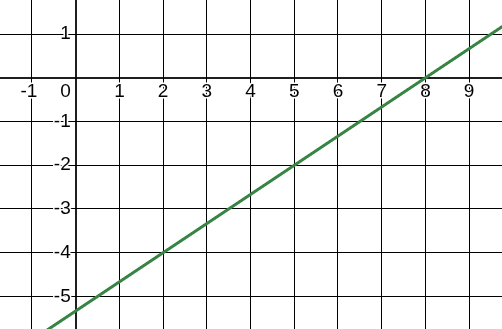
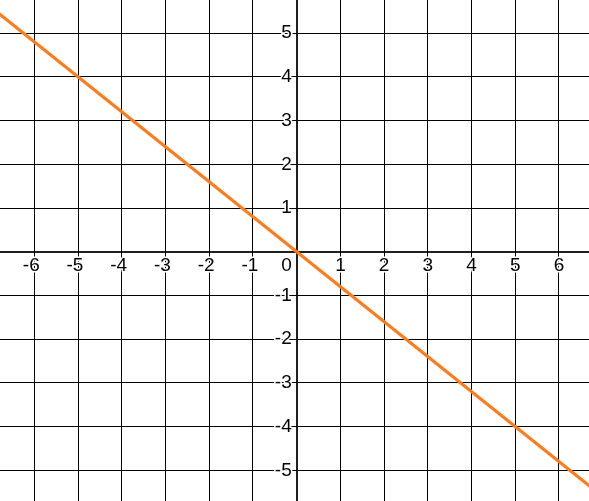
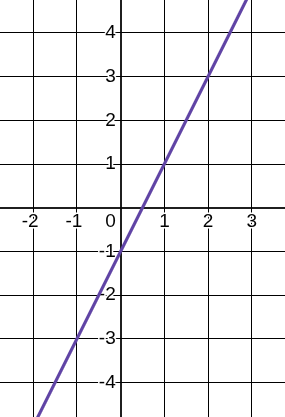
Linear equations can be graphed by plotting points or using the slope-intercept form , where is the slope and is the y-intercept.
Slope (): The rate of change; rise over run.
Y-intercept (): The point where the line crosses the y-axis.
To graph: Start at the y-intercept, use the slope to find another point, and draw the line through both points.
Finding the Equation of a Line
The equation of a line can be found using two points or a point and a slope. The slope-intercept form is .
Given two points and :
Find the slope:
Use one point and the slope to solve for in
Parallel lines: Have the same slope.
Perpendicular lines: Slopes are negative reciprocals ().
Graphing Linear Inequalities
To graph a linear inequality, first graph the corresponding equation as a line. Use a solid line for ≤ or ≥, and a dashed line for < or >. Shade the region that satisfies the inequality.
Example: For , graph with a dashed line and shade above the line.
Summary Table: Key Properties of Linear Equations
Form | Slope | Y-intercept | X-intercept |
|---|---|---|---|
(if ) | |||
Additional info:
These notes cover the essential skills for beginning and intermediate algebra, including evaluating expressions, simplifying, solving equations and inequalities, translating word problems, and graphing linear equations and inequalities. The included images directly support the explanation of plotting points and graphing lines, which are core skills in Chapter 3.
