 Back
BackChapter 1 Study Notes: Introduction to Algebraic Expressions
Study Guide - Smart Notes
 Tailored notes based on your materials, expanded with key definitions, examples, and context.
Introduction to Algebra
Vocabulary and Key Concepts
Algebra is the branch of mathematics that uses symbols, usually letters, to represent numbers and express mathematical relationships. Understanding the basic vocabulary is essential for success in algebra.
Variable: A symbol (often a letter) that represents an unknown value. Example: x, m.
Constant: A fixed value that does not change. Example: 5, -3.
Operation: Mathematical processes such as addition, subtraction, multiplication, and division.
Evaluate: To find the value of an expression by substituting values for variables.
Algebraic Expression: A combination of variables, constants, and operations (without an equals sign). Example: 2x + 3.
Algebraic Equation: A statement that two expressions are equal, containing an equals sign. Example: 2x + 3 = 7.
Translation of Words to Algebraic Expressions:
Addition: added to, sum of, plus, more than, increased by
Subtraction: subtracted, minus, difference, less than, decreased by
Multiplication: multiplied by, product of, times, twice, of
Division: divided by, quotient of, ratio of, per
Equality: equal, is, are
Examples:
The product of 9 and twice m:
Thirteen less than one quarter of some number:
What number added to 73 is 201?
Common Laws Found in Algebra
Commutative, Associative, and Distributive Laws
Algebra relies on several fundamental laws that govern how numbers and expressions can be manipulated.
Commutative Law: The order of addition or multiplication does not affect the result.
Addition:
Multiplication:
Associative Law: The grouping of addition or multiplication does not affect the result.
Addition:
Multiplication:
Distributive Law: Multiplication distributes over addition.
Examples:
Commutative Law of Multiplication:
Associative Law of Addition:
Distributive Law:
Factoring using Distributive Law:
Fraction Notation
Prime and Composite Numbers; Fraction Operations
Fractions represent parts of a whole and are fundamental in algebra. Understanding prime and composite numbers is important for simplifying fractions.
Prime Number: A natural number greater than 1 that has no positive divisors other than 1 and itself. Example: 2, 3, 5, 7.
Composite Number: A natural number greater than 1 that is not prime; it has more than two positive divisors. Example: 4, 6, 8, 9.
Prime Factorization Examples:
180:
210:
Fraction Notation:
Numerator: The top part of a fraction, representing the number of parts considered.
Denominator: The bottom part of a fraction, representing the total number of equal parts.
Identity Property of 1: For any number ,
Operations with Fractions:
Multiplication:
Division:
Addition/Subtraction (common denominator):
Examples:
Positive and Negative Real Numbers
Integers, Number Line, and Absolute Value
Real numbers include both positive and negative values, as well as zero. Integers are whole numbers that can be positive, negative, or zero. The number line is a visual tool for understanding these concepts.
Negative Integers: Numbers less than zero (e.g., -1, -2, -3).
Positive Integers: Numbers greater than zero (e.g., 1, 2, 3).
Opposites: Two numbers that are the same distance from zero but on opposite sides of the number line.
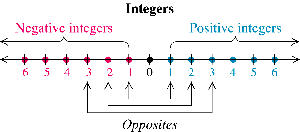
Inequalities:
<: less than
≤: less than or equal to
>: greater than
≥: greater than or equal to
Absolute Value: is the distance of a from zero on the number line.
Adding and Subtracting with the Number Line
Rules and Examples
Adding and subtracting real numbers can be visualized on the number line. The direction of movement depends on the sign of the number being added or subtracted.
To add: Start at a and move right if b is positive, left if b is negative.
To subtract: Move left for positive values, right for negative values.
Examples:
Add:
Subtract:
Rules for Addition/Subtraction of Real Numbers
Positive numbers: Add as usual; answer is positive.
Negative numbers: Add absolute values; answer is negative.
Positive and negative: Subtract smaller absolute value from larger; answer takes sign of larger number.
Identity Property of 0: For any number ,
Removing Parentheses with Double Signs:
Like Signs: ,
Unlike Signs: ,
Examples:
Add:
Subtract:
Subtract:
Simplify:
Combine like terms:
Combine like terms:
Multiplying and Dividing Real Numbers
Rules and Examples
Multiplication and division of real numbers follow specific rules regarding signs.
Multiply or divide absolute values as indicated.
If signs are the same, the answer is positive.
If signs are different, the answer is negative.
Division involving Zero:
For any real number , is undefined.
For ,
Examples:
Multiply:
Divide:
Multiply:
Using negatives in fractions:
Exponential Notation and Order of Operations
Exponents and Calculation Rules
Exponential notation is used to represent repeated multiplication. The order of operations ensures that expressions are evaluated correctly.
Exponential Notation: For any natural number , means ($n$ factors).
Order of Operations:
Simplify within innermost grouping symbols: ( ), [ ], { }, and above/below fraction bars.
Simplify all exponential expressions.
Perform all multiplications and divisions, left to right.
Perform all additions and subtractions, left to right.
Examples:
Find when and :
Opposite of a Sum:
Examples:
Simplify:
Simplify:
