 Back
BackChapter 1: Variables, Real Numbers, and Mathematical Models – Study Notes
Study Guide - Smart Notes
 Tailored notes based on your materials, expanded with key definitions, examples, and context.
Variables, Real Numbers, and Mathematical Models
Introduction to Algebra: Variables and Mathematical Models
This chapter introduces the foundational concepts of algebra, focusing on variables, algebraic expressions, equations, and mathematical models. Understanding these concepts is essential for solving real-world problems using algebraic methods.
Variables and Algebraic Expressions
Variable: A letter that represents a variety of different numbers. Common variables include x, y, and z.
Algebraic Expression: A combination of variables and numbers using operations such as addition, subtraction, multiplication, division, powers, or roots. Examples: 3x + 5, x^2 - 7.
Example: The expression 5 + 3x is algebraic because it combines a variable and numbers using addition and multiplication.
Order of Operations
To evaluate algebraic expressions correctly, follow the order of operations:
1. Perform all operations within grouping symbols (parentheses, brackets).
2. Carry out multiplications and divisions from left to right.
3. Complete additions and subtractions from left to right.
Example: Evaluate 5 + 3x for x = 2:
Replace x with 2: 5 + 3(2)
Multiply: 5 + 6
Add: 11
Example: Evaluate 5(x + 7) for x = 2:
Replace x with 2: 5(2 + 7)
Add inside parentheses: 5(9)
Multiply: 45
Translating English Phrases into Algebraic Expressions
Algebra often requires translating verbal statements into mathematical expressions.
"The sum of a number and 7" → x + 7
"Ten less than a number" → x - 10
"Twice a number, decreased by 6" → 2x - 6
"The product of 8 and a number" → 8x
"Three more than the quotient of a number and 11" → (x / 11) + 3
Equations and Solutions
An equation is a statement that two algebraic expressions are equal, always containing the equality symbol =. A solution to an equation is a value for the variable that makes the equation true.
Example: Is x = 5 a solution to 6x + 16 = 46?
Substitute: 6(5) + 16 = 30 + 16 = 46
Since both sides equal 46, x = 5 is a solution.
Example: Is z = 7 a solution to 2(z + 1) = 5(z - 2)?
Substitute: 2(8) = 16, 5(5) = 25
Since 16 ≠ 25, z = 7 is not a solution.
Translating English Sentences into Algebraic Equations
Translating sentences into equations is a key skill in algebra. Look for words that indicate equality, such as "equals," "gives," "yields," "is the same as," or "is/was/will be."
"The product of 8 and a number is 48" → 8x = 48
"Nine less than 4 times a number gives 26" → 4x - 9 = 26
Formulas and Mathematical Models
A formula is an equation that expresses a relationship between two or more variables. The process of finding formulas to describe real-world phenomena is called mathematical modeling. These formulas, along with the meaning assigned to the variables, are called mathematical models.
Example: The formula for estimating temperature based on cricket chirps is a mathematical model.
Mathematical Models: Probability of Divorce by Wife's Age at Marriage
Mathematical models can be used to approximate real-world data. For example, the probability of divorce can be modeled based on the wife's age at marriage.
Model 1: Wife under 18 at marriage:
Model 2: Wife over 25 at marriage:
Where n is the number of years after marriage and d is the percentage of marriages ending in divorce.
Example: For a wife under 18, after 15 years:
So, 65% of marriages end in divorce after 15 years (model prediction).
According to the line graph, the actual percentage is 60%. The model overestimates by 5%.
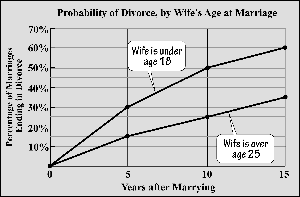
Wife's Age at Marriage | Mathematical Model | Predicted Divorce Rate after 15 Years | Actual Divorce Rate (Graph) | Difference |
|---|---|---|---|---|
Under 18 | 65% | 60% | +5% | |
Over 25 | 36% | 36% | 0% |
Additional info: Mathematical models are useful for making predictions, but they may not always match real-world data exactly. Differences can arise due to simplifications or assumptions in the model.
