 Back
BackCircles, Spheres, and Polygons: Key Concepts and Definitions
Study Guide - Smart Notes
 Tailored notes based on your materials, expanded with key definitions, examples, and context.
Circles and Spheres
Definition and Properties of Circles
A circle is a fundamental geometric shape in the plane. It is defined as the set of all points in a plane that are a fixed distance (called the radius) from a fixed point (called the center).
Radius: The distance from the center of the circle to any point on the circle.
Diameter: The distance across the circle through its center; it is twice the radius.
Mathematical Definition: The set of all points in a plane such that , where is the center and is the radius.
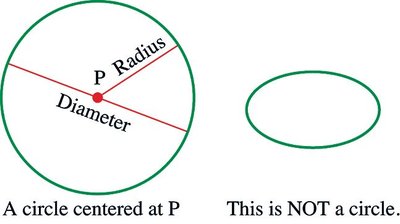
Example: The equation of a circle centered at with radius $5$
How Circles Can Meet
Two circles in a plane can relate to each other in several distinct ways:
They do not meet (no intersection).
They meet at exactly one point (tangent circles).
They meet at exactly two points (intersecting circles).
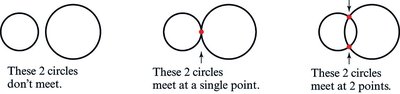
Example: If two circles have centers and and both have radius , they are tangent if .
Definition and Properties of Spheres
A sphere is the three-dimensional analogue of a circle. It is the set of all points in space that are a fixed distance from a fixed point.
Radius: The distance from the center of the sphere to any point on the sphere.
Diameter: Twice the radius, the longest distance through the center of the sphere.
Mathematical Definition: The set of all points such that .
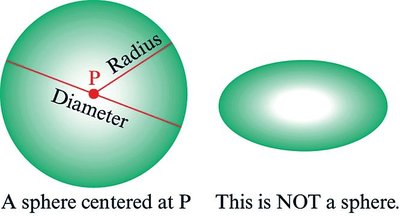
Example: The equation of a sphere centered at with radius $4$
How Spheres Can Meet
Two spheres in space can relate in the following ways:
They do not meet (no intersection).
They meet at exactly one point (tangent spheres).
They meet along a circle (intersecting spheres).
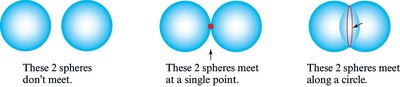
Example: If two spheres have centers and and both have radius , they are tangent if .
Polygons
Definition and Classification of Polygons
A polygon is a closed plane figure formed by a finite number of straight line segments (called sides) that meet only at their endpoints (called vertices).
Regular Polygon: All sides and all angles are equal.
Irregular Polygon: Sides and/or angles are not all equal.

Examples:
Pentagon: 5 sides
Hexagon: 6 sides
Octagon: 8 sides
Special Quadrilaterals
Quadrilaterals are polygons with four sides. There are several important types:
Name | Definition |
|---|---|
Quadrilateral | Four-sided polygon |
Trapezoid | Quadrilateral with at least two sides parallel (or exactly two, depending on definition) |
Rectangle | Quadrilateral with four right angles |
Square | Quadrilateral with four right angles and all sides equal |
Rhombus | Quadrilateral with all sides equal |
Parallelogram | Quadrilateral with opposite sides parallel |
Triangles and Their Types
Triangles are polygons with three sides. They can be classified by their sides or angles:
Name | Definition |
|---|---|
Triangle | Three-sided polygon |
Equilateral Triangle | All sides are equal |
Isosceles Triangle | At least two sides are equal |
Right Triangle | Has one right angle (90°) |
Hypotenuse | The side opposite the right angle in a right triangle |
Acute Triangle | All angles are less than 90° |
Obtuse Triangle | Has one angle greater than 90° |
Using Venn Diagrams to Show Relationships
Venn diagrams are useful for sorting and visualizing relationships between sets, such as numbers or shapes with different properties. For example, numbers can be sorted into sets like odd numbers and prime numbers, and shapes can be sorted by properties such as number of sides or angle types.
Example: Place the numbers 1 to 15 in a Venn diagram to show which are odd, which are prime, and which are both.
Additional info: Venn diagrams are also used in geometry to classify shapes based on shared properties, such as regularity, number of sides, or angle measures.
