Back
BackComprehensive Study Notes for Beginning-Intermediate Algebra
Study Guide - Smart Notes
 Tailored notes based on your materials, expanded with key definitions, examples, and context.
Review of Real Numbers
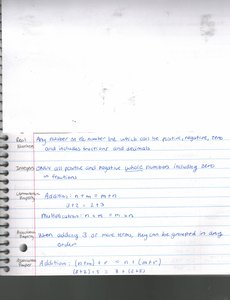
Definition of Real Numbers
Real numbers include all numbers that can be found on the number line, encompassing positive, negative, zero, fractions, and decimals.
Key Point: Real numbers are the foundation of algebra and include rational and irrational numbers.
Example: -3, 0, 2.5, and √2 are all real numbers.
Integers
Integers are a subset of real numbers, including positive and negative whole numbers, as well as zero.
Key Point: Integers do not include fractions or decimals.
Example: -2, 0, 7
Commutative and Associative Properties
These properties describe how numbers can be grouped or ordered in addition and multiplication.
Commutative Property: and
Associative Property: and
Example:
Identity Properties
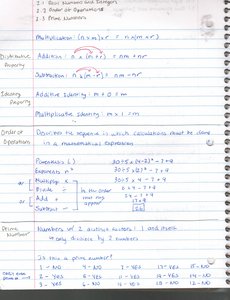
Identity properties state that adding zero or multiplying by one does not change the value of a number.
Additive Identity:
Multiplicative Identity:
Order of Operations
Order of operations determines the sequence in which calculations are performed.
Key Point: PEMDAS: Parentheses, Exponents, Multiplication/Division, Addition/Subtraction
Example:
Prime Numbers
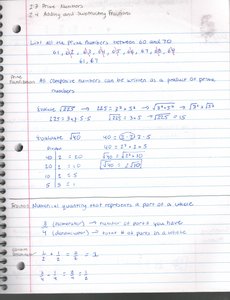
Prime numbers are natural numbers greater than 1 that have only two factors: 1 and themselves.
Key Point: Prime numbers are used in factorization and number theory.
Example: 2, 3, 5, 7, 11, 13, 17, 19
Fractions
Definition and Types of Fractions
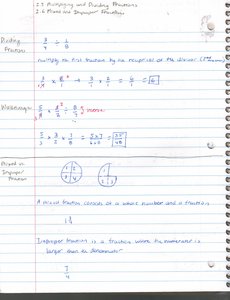
A fraction represents a part of a whole and is written as , where is the numerator and is the denominator.
Proper Fraction: Numerator is less than denominator.
Improper Fraction: Numerator is greater than or equal to denominator.
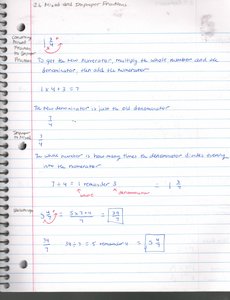
Mixed Number: Combination of a whole number and a fraction.
Adding and Subtracting Fractions
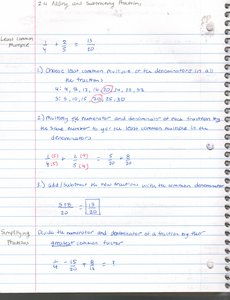
To add or subtract fractions, a common denominator is required.
Find the least common multiple (LCM) of the denominators.
Convert each fraction to an equivalent fraction with the common denominator.
Add or subtract the numerators.
Simplifying Fractions
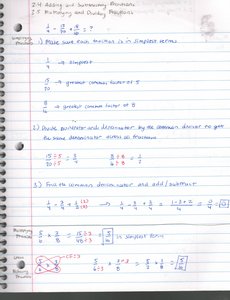
To simplify a fraction, divide the numerator and denominator by their greatest common factor (GCF).
Example:
Multiplying and Dividing Fractions
Multiplication and division of fractions involve multiplying numerators and denominators, or using the reciprocal for division.
Multiplication:
Division:
Exponents
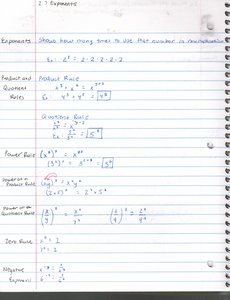
Definition and Rules of Exponents
Exponents indicate how many times a number is multiplied by itself.
Product Rule:
Quotient Rule:
Power Rule:
Zero Rule:
Negative Exponent:
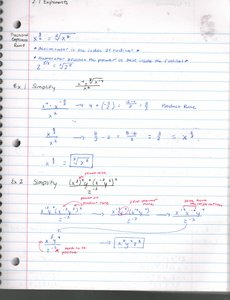
Examples and Applications
Exponents are used in scientific notation, growth models, and algebraic simplification.
Example:
Radicals
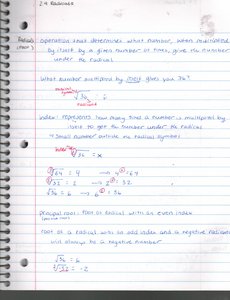
Definition and Properties of Radicals
Radicals represent roots, such as square roots or cube roots. The principal root is the positive root for even indices.
Key Point: is the square root of .
Example:
Simplifying Radicals
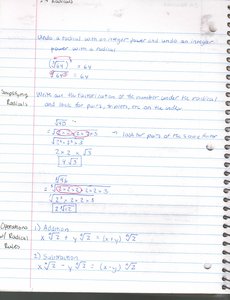
To simplify radicals, factor the number under the radical and extract perfect squares.
Example:
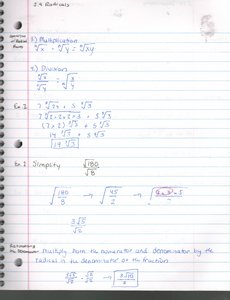
Operations with Radicals
Radicals can be added, subtracted, multiplied, and divided, following specific rules.
Addition/Subtraction: Only like radicals can be combined.
Multiplication:
Division:
Logarithms
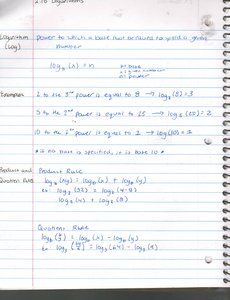
Definition and Properties of Logarithms
A logarithm is the power to which a base must be raised to yield a given number.
Key Point: means
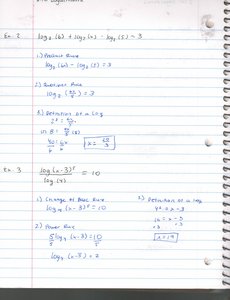
Product Rule:
Quotient Rule:
Power Rule:
Change of Base Rule:
Decimals
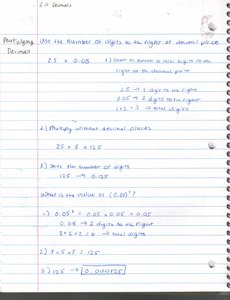
Operations with Decimals
Decimals are numbers with a fractional part separated by a decimal point. Operations include addition, subtraction, multiplication, and division.
Key Point: Line up decimal places for addition and subtraction.
Multiplication: Multiply as whole numbers, then place the decimal point according to the total number of decimal places.
Ratios and Proportions
Definition and Applications
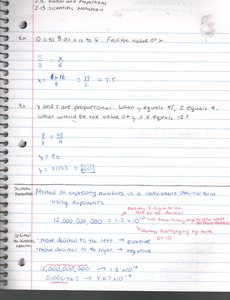
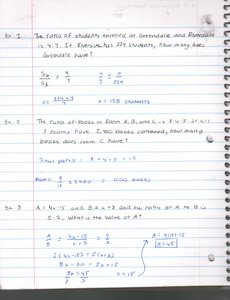
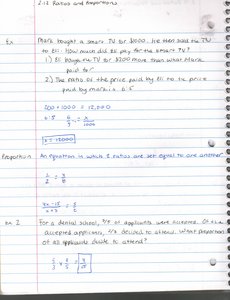
A ratio compares two quantities, while a proportion is an equation stating that two ratios are equal.
Key Point: Ratios are written as or .
Proportion:
Example: If the ratio of boys to girls is 2:3, then for every 2 boys, there are 3 girls.
Scientific Notation
Definition and Usage
Scientific notation expresses numbers as a product of a coefficient and a power of ten.
Key Point: , where and is an integer.
Example:
Sequences
Arithmetic Sequences
An arithmetic sequence is an ordered set of numbers with a constant difference between consecutive terms.
General Term:
Sum of Sequence:
Example: 3, 5, 7, 9, ... (common difference )
Finding Terms and Sums
To find the nth term or the sum of an arithmetic sequence, use the formulas above.
Example: Find the 9th term of the sequence 3, 5, 7, ...