 Back
BackEquations, Proportional Reasoning, and Visual Models in Algebra
Study Guide - Smart Notes
 Tailored notes based on your materials, expanded with key definitions, examples, and context.
Proportional and Inverse Proportional Reasoning
Understanding Proportional Relationships
Proportional and inverse proportional relationships are fundamental concepts in algebra, especially when analyzing how two quantities change in relation to each other.
Proportional Relationship: Two quantities are proportional if they increase or decrease together at the same rate. The ratio between them remains constant.
Inverse Proportional Relationship: Two quantities are inversely proportional if one increases while the other decreases such that their product remains constant.
Example: If 6 teams can build a house in 80 days, and you want to finish in 16 days, the number of teams and days are inversely proportional because more teams mean fewer days needed.
Equation: If t is the number of teams and d is the number of days, then:
where k is a constant (here, ). To finish in 16 days:
teams
Equations in Algebra
Definition and Types of Equations
An equation is a mathematical statement asserting that two expressions are equal. Equations are used to relate quantities, describe properties, and solve problems.
Formulas: Relate two or more quantities that vary together (e.g., for area of a rectangle).
Identities: Describe properties that are always true (e.g., ).
Calculation Results: Show the result of a computation (e.g., ).
Equations to Solve: Provide a question to be answered (e.g., ).
Solving Equations
To solve an equation means to find all values of the variable(s) that make the equation true. These values are called solutions.
Some equations have one solution, many solutions, or no solution at all.
Solving often involves isolating the variable using algebraic operations.
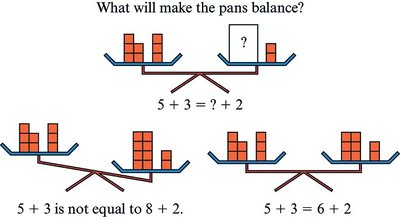
Visualizing Equations with the Balance Model
The balance model is a visual tool for understanding equations. Each side of the balance represents one side of the equation. The goal is to keep the balance level, which means both sides are equal.
Adding or removing the same amount from both sides keeps the balance.
This model helps visualize why the same operation must be performed on both sides when solving equations.
Solving Algebra Word Problems with Strip Diagrams and Algebra
Using Strip Diagrams
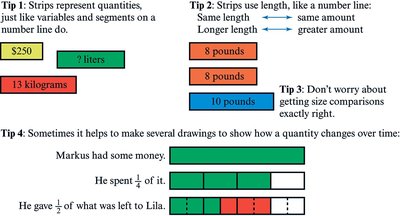
Strip diagrams (also called bar models) are visual representations that help break down and solve word problems by showing quantities as lengths of strips.
Tip 1: Strips represent quantities, just like variables and segments on a number line.
Tip 2: Strips use length to show amount: same length means same amount; longer length means greater amount.
Tip 3: Exact size comparison is not necessary—focus on the relationships.
Tip 4: For multi-step problems, use several drawings to show how quantities change over time.
Solving with Algebra Supported by Strip Diagrams
Strip diagrams can be used alongside algebraic equations to clarify the relationships in a problem. For example, if Markus spends of his money and gives away of what is left, a strip diagram can help visualize each step before writing the equations.
Draw strips to represent the total, the amount spent, and the amount given away.
Translate the visual model into algebraic expressions and equations.
Solving with Algebraic Equations Alone
Once comfortable with the relationships, you can set up and solve equations directly from the problem statement, using variables to represent unknowns and applying algebraic techniques to find solutions.
Identify the unknown(s) and assign variables.
Write equations based on the relationships described in the problem.
Solve for the variable(s) using appropriate algebraic methods.
