 Back
BackExponents and Polynomials: Properties, Operations, and Applications
Study Guide - Smart Notes
 Tailored notes based on your materials, expanded with key definitions, examples, and context.
Exponents and Their Properties
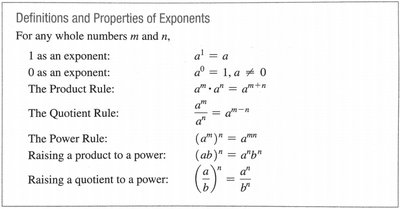
Definitions and Properties of Exponents
Exponents are a way to represent repeated multiplication of the same number or variable. Understanding their properties is essential for simplifying expressions and solving equations in algebra.
1 as an exponent: Any number raised to the power of 1 is itself:
0 as an exponent: Any nonzero number raised to the power of 0 is 1:
The Product Rule: When multiplying like bases, add the exponents:
The Quotient Rule: When dividing like bases, subtract the exponents:
The Power Rule: When raising a power to another power, multiply the exponents:
Raising a product to a power: Distribute the exponent to each factor:
Raising a quotient to a power: Distribute the exponent to both numerator and denominator:
0 as an Exponent
Evaluating Expressions with Zero Exponents
Zero exponents simplify expressions and are used frequently in algebraic manipulations.
Key Point: Any nonzero base raised to the zero power equals 1.
Example:
Example:
The Product Rule
Multiplying Powers with the Same Base
The product rule allows us to combine exponents when multiplying like bases.
Key Point: Add exponents when multiplying like bases.
Example:
Example:
The Quotient Rule
Dividing Powers with the Same Base
The quotient rule is used to simplify expressions where like bases are divided.
Key Point: Subtract exponents when dividing like bases.
Example:
Example:
The Power Rule
Raising a Power to a Power
When an exponent is raised to another exponent, multiply the exponents.
Key Point:
Example:
Example:
Raising a Product to a Power
Distributing Exponents Over Products
When raising a product to a power, apply the exponent to each factor inside the parentheses.
Key Point:
Example:
Example:
Raising a Quotient to a Power
Distributing Exponents Over Quotients
When raising a quotient to a power, apply the exponent to both the numerator and denominator.
Key Point:
Example:
Example:
Negative Exponents and Scientific Notation
Negative Integers as Exponents
Negative exponents represent reciprocals. They are useful for expressing very small numbers and for simplifying algebraic expressions.
Key Point:
Example:
Example:
Example:
Example:
Scientific Notation
Scientific notation is a way to express very large or very small numbers using powers of ten. The general form is , where and is an integer.
To convert from scientific notation to decimal:
If is positive, move the decimal point right places.
If is negative, move the decimal point left places.
Example:
Example:
Calculator Example: (rounded to two significant digits)
Calculator Example: (rounded to two significant digits)
Additional info: Positive exponents are used for large numbers, negative exponents for small numbers between 0 and 1.
Polynomials and Polynomial Functions
Terms, Monomials, and Polynomials
A term is a product of constants and/or variables. A monomial is a single term with no division by variables. A polynomial is a sum of monomials.
Examples of polynomials: ,
Not polynomials: , , ,
Degree, Leading Term, and Leading Coefficient
The degree of a term is the sum of the exponents of its variables. The leading term is the term with the highest degree in a polynomial written in descending order. The leading coefficient is the coefficient of the leading term.
Example: For , written in descending order:
Leading term:
Leading coefficient:
Degree: $3$
Like Terms
Like terms have exactly the same variables with the same exponents, or are constants.
Example:
Evaluating Polynomials
To evaluate a polynomial, substitute the given values for the variables and simplify.
Example: For at :
Addition and Subtraction of Polynomials
Combining Like Terms
To add or subtract polynomials, combine like terms and write the result in descending order of degree.
Example:
Example:
Example:
Application: Perimeter of a Rectangle
If a rectangle has length feet and width feet, the perimeter is:
Multiplication of Polynomials
Multiplying Monomials
Multiply the coefficients and add the exponents of like variables.
Example:
Example:
Multiplying a Monomial and a Polynomial
Distribute the monomial to each term in the polynomial.
Example:
Example:
Multiplying Two Polynomials
Distribute each term in the first polynomial to every term in the second polynomial.
Example:
Example:
Example:
Application: Area of Squares
If one square has side length and another has side length , their total area is:
Area of first:
Area of second:
Total area:
Polynomials in Several Variables
Evaluating Polynomials with Multiple Variables
Substitute the given values for each variable and simplify.
Example: For at , :
Application: Caloric Needs Formula
The number of calories needed each day by a moderately active man can be estimated by:
For kg, cm, years: (rounded to nearest whole calorie)
Like Terms in Several Variables
Like terms must have the same variables with the same exponents, regardless of order.
Like terms: and
Not like terms: and
Operations with Polynomials in Several Variables
Subtract:
Multiply:
