 Back
BackFactoring and Applications: Study Guide for Intermediate Algebra
Study Guide - Smart Notes
 Tailored notes based on your materials, expanded with key definitions, examples, and context.
Chapter 5: Factoring and Applications
5.1 The Greatest Common Factor; Factoring by Grouping
This section introduces the concept of factoring, focusing on finding the greatest common factor (GCF) and factoring by grouping. Factoring is a fundamental skill in algebra used to simplify expressions and solve equations.
Definition: To factor a number means to break it down into multiplication of its prime factors.
Prime Number: A number that has only two factors: 1 and itself.
Factoring: The process of writing a number or expression as a product of its factors.
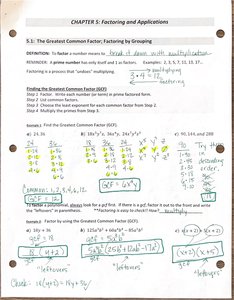
Finding the Greatest Common Factor (GCF):
List all factors of each term.
Identify the common factors.
The GCF is the largest factor common to all terms.
Example: Find the GCF of 12 and 18. Factors of 12: 1, 2, 3, 4, 6, 12 Factors of 18: 1, 2, 3, 6, 9, 18 GCF = 6
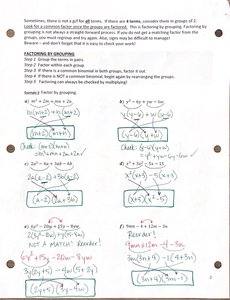
Factoring by Grouping: Used when there are four terms in an expression. Group terms in pairs and factor out the GCF from each pair.
Step 1: Group terms in pairs.
Step 2: Factor the GCF from each group.
Step 3: If the resulting binomials are the same, factor them out.
Example: Group: Factor: Final:
5.2 Factoring Trinomials
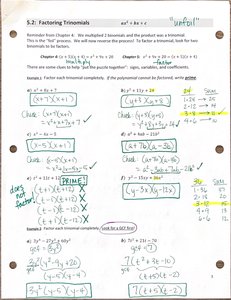
This section covers factoring trinomials of the form . The process involves finding two numbers that multiply to and add to .
Trinomial: A polynomial with three terms.
Factoring: Reverse the process of multiplying binomials ("unFOIL").
Example: Factor Find two numbers that multiply to 6 and add to 5: 2 and 3. Factor:
5.3 More on Factoring Trinomials
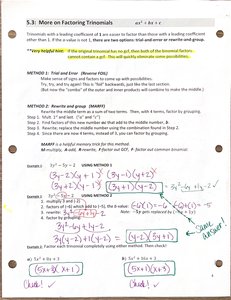
Trinomials with a leading coefficient other than 1 require special techniques. Two methods are commonly used: trial and error, and factor by grouping.
Trial and Error: List possible pairs of factors and test combinations.
Factor and Group: Split the middle term and group for factoring.
Example: Factor Split: Group: Factor: Final:
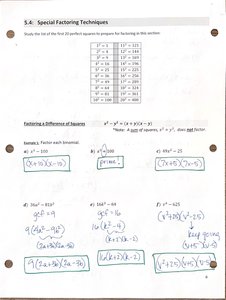
5.4 Special Factoring Techniques
Special techniques are used for factoring perfect squares, differences of squares, and differences of cubes.
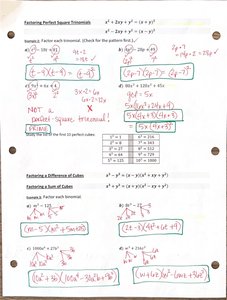
Perfect Square Trinomial:
Difference of Squares:
Difference of Cubes:
Example: Factor
Factoring Perfect Square Trinomials:
Check if the first and last terms are perfect squares.
Check if the middle term is twice the product of the square roots.
Example:
5.5 Solving Quadratic Equations Using the Zero-Factor Property
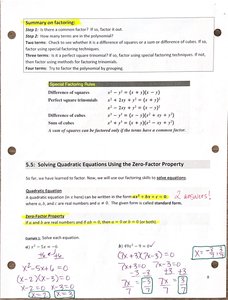
Quadratic equations can be solved by factoring and applying the zero-factor property. If a product of factors equals zero, at least one factor must be zero.
Zero-Factor Property: If , then or .
Write the equation in standard form and factor.
Set each factor equal to zero and solve for the variable.
Example: Solve Factor: Solutions: ,
5.6 Applications of Quadratic Equations
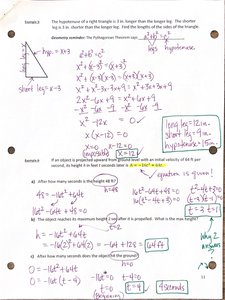
Quadratic equations are used to solve real-world problems, such as area, consecutive integers, and geometric applications.
Assign a variable to the unknown.
Write an equation based on the problem.
Solve the equation by factoring.
Check the solution in the context of the problem.
Example: The hypotenuse of a right triangle is 3 inches longer than the longer leg. The shorter leg is 3 inches shorter than the longer leg. Find the lengths of the sides.
Summary of Factoring Techniques
Factoring is a key skill in algebra, used to simplify expressions and solve equations. The main techniques include:
Factoring out the GCF
Factoring by grouping
Factoring trinomials
Special factoring formulas (difference of squares, cubes, perfect squares)
Solving quadratic equations by factoring
Factoring Rule | Formula |
|---|---|
Difference of Squares | |
Perfect Square Trinomial | |
Difference of Cubes | |
Sum of Cubes |
Additional info: These notes cover all major factoring techniques and their applications, suitable for beginning-intermediate algebra students.
