 Back
BackGraphing Linear Equations and Finding Midpoints in the Coordinate Plane
Study Guide - Smart Notes
 Tailored notes based on your materials, expanded with key definitions, examples, and context.
Linear Equations in Two Variables
Standard Form of a Linear Equation
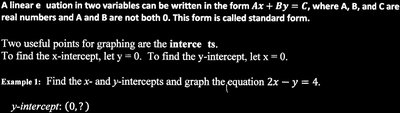
A linear equation in two variables can be written in the form , where A, B, and C are real numbers, and A and B are not both zero. This is called the standard form of a linear equation.
Standard form:
Variables: and
Coefficients: , (not both zero)
Intercepts of a Line
Two useful points for graphing are the x-intercept and y-intercept:
x-intercept: The point where the line crosses the x-axis ().
y-intercept: The point where the line crosses the y-axis ().
To find the intercepts, substitute 0 for the other variable and solve:
To find the x-intercept, let and solve for .
To find the y-intercept, let and solve for .
Example: Find the x- and y-intercepts and Graph the Equation
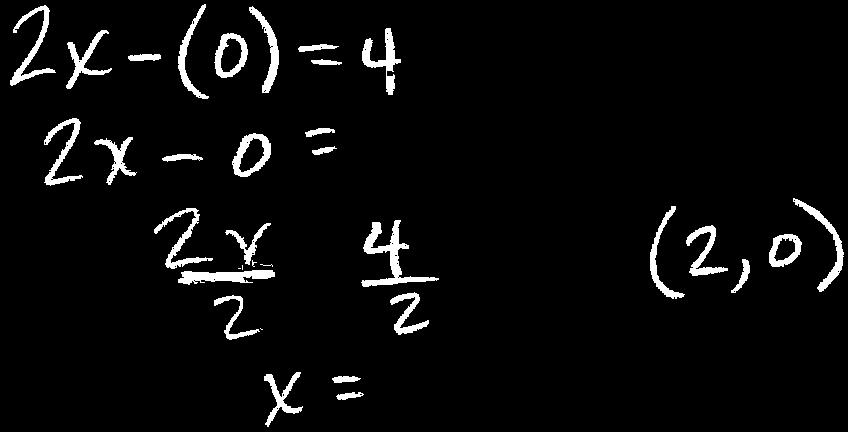
Find the x-intercept: Set :
The x-intercept is .
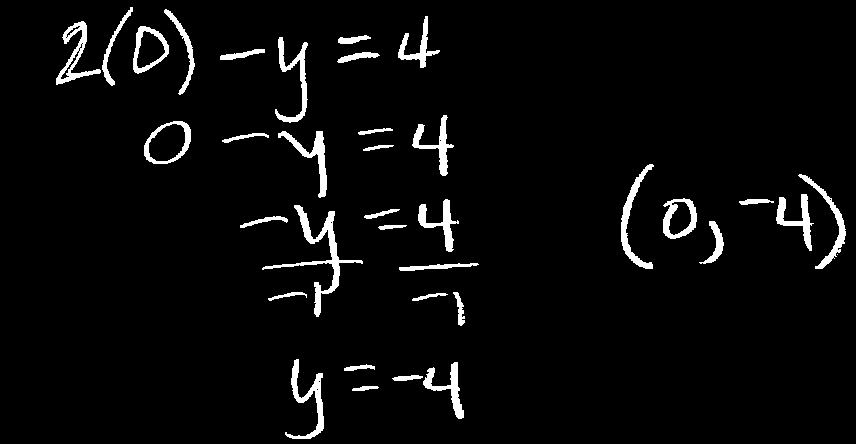
Find the y-intercept: Set :
The y-intercept is .
Graphing the Line
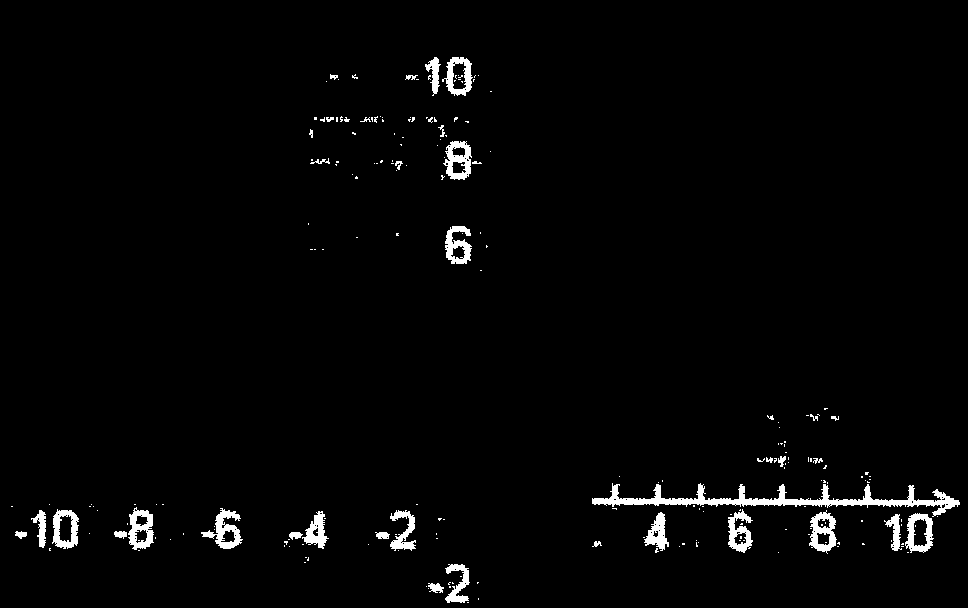
Plot the intercepts and on the coordinate plane, then draw a straight line through these points.
Special Cases: Horizontal and Vertical Lines
Equations with One Variable
If the equation is missing a variable, it represents a special case:
Horizontal line: (where is a constant)
Vertical line: (where is a constant)
Example: Graph the Horizontal Line
This line passes through all points with -coordinate 3.
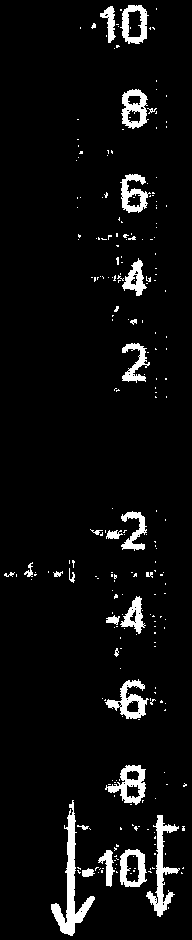
Example: Graph the Vertical Line
This line passes through all points with -coordinate -2.
Graphing by Slope-Intercept Form
Slope-Intercept Form
The slope-intercept form of a line is , where is the slope and is the y-intercept.
Slope (): The rate of change, or how much increases or decreases as increases by 1.
Y-intercept (): The value of when .
To graph a line in standard form, you can rewrite it in slope-intercept form or use a t-table to plot points.
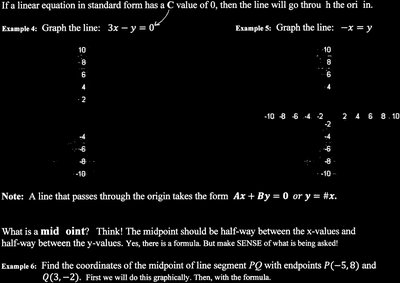
Lines Passing Through the Origin
If a linear equation in standard form has , the line passes through the origin .
Example: or
Midpoint of a Line Segment
Definition and Formula
The midpoint of a line segment with endpoints and is the point halfway between them. The formula is:

Example: Find the Midpoint of and
Calculate the average of the x-coordinates:
Calculate the average of the y-coordinates:
The midpoint is .
Slope of a Line
Slope Formula
The slope of a line through two points and is:
Positive slope: Line rises from left to right.
Negative slope: Line falls from left to right.
Zero slope: Horizontal line.
Undefined slope: Vertical line.
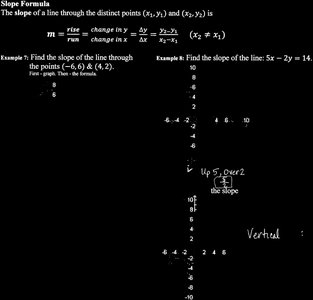
Example: Find the Slope of the Line through and

Example: Find the Slope of the Line
Rewrite in slope-intercept form:
The slope is .
Summary Table: Types of Lines and Their Equations
Type of Line | Equation | Slope |
|---|---|---|
General (oblique) | (finite) | |
Horizontal | $0$ | |
Vertical | Undefined | |
Through origin | or | (finite) |
Additional info: This table summarizes the main types of lines encountered in algebra and their properties.
