 Back
BackGuided Study: Fractions, Decimals, Percents, and Exponents (Beginning-Intermediate Algebra)
Study Guide - Smart Notes
 Tailored notes based on your materials, expanded with key definitions, examples, and context.
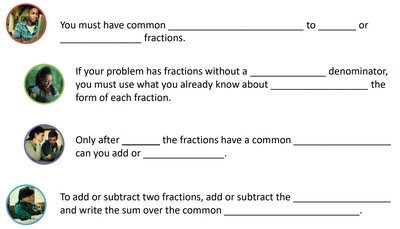
Q1. What must you do before adding or subtracting fractions?
Background
Topic: Adding and Subtracting Fractions
This question tests your understanding of the process for adding and subtracting fractions, specifically the importance of having a common denominator.
Key Terms and Concepts:
Common Denominator: A shared multiple of the denominators of two or more fractions.
Numerator: The top number of a fraction.
Denominator: The bottom number of a fraction.
Step-by-Step Guidance
Identify the denominators of the fractions you want to add or subtract.
Find the least common denominator (LCD) for the fractions.
Rewrite each fraction as an equivalent fraction with the LCD as the new denominator.
Once the denominators are the same, you can add or subtract the numerators and keep the common denominator.
Try solving on your own before revealing the answer!
Q2. How do you multiply fractions?
Background
Topic: Multiplying Fractions
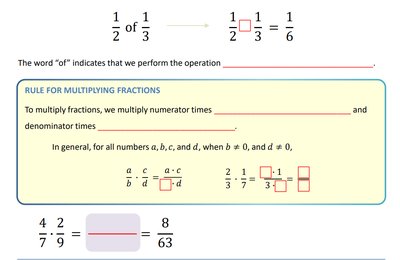
This question checks your ability to multiply two fractions and understand the rule for multiplying numerators and denominators.
Key Terms and Formulas:
To multiply fractions:
Numerator: Top number; Denominator: Bottom number
Step-by-Step Guidance
Multiply the numerators of the two fractions to get the new numerator.
Multiply the denominators of the two fractions to get the new denominator.
Simplify the resulting fraction if possible by dividing both numerator and denominator by their greatest common factor.

Try solving on your own before revealing the answer!
Q3. What is the process for dividing fractions?
Background
Topic: Dividing Fractions
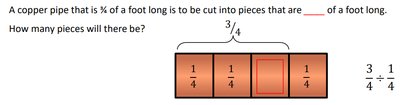
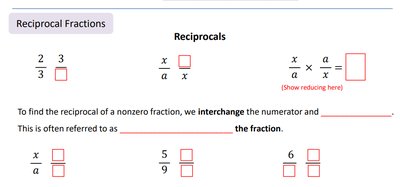
This question tests your understanding of how to divide one fraction by another using the reciprocal.
Key Terms and Formulas:
Reciprocal: The reciprocal of is .
To divide fractions:
Step-by-Step Guidance
Identify the two fractions involved in the division.
Find the reciprocal of the second fraction (flip numerator and denominator).
Change the division problem to a multiplication problem using the reciprocal.
Multiply the fractions as you would in multiplication (numerator times numerator, denominator times denominator).
Try solving on your own before revealing the answer!
Q4. How do you convert a fraction to a decimal?
Background
Topic: Converting Fractions to Decimals
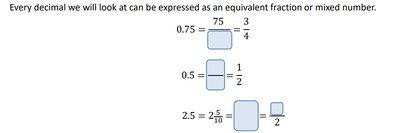
This question checks your ability to change a fraction into its decimal form by dividing the numerator by the denominator.
Key Terms and Formulas:
Fraction:
Decimal: The result of dividing by
Step-by-Step Guidance
Take the numerator of the fraction and divide it by the denominator using long division or a calculator.
If the division ends, you have a terminating decimal; if it repeats, you have a repeating decimal.
Write the decimal equivalent of the fraction.
Try solving on your own before revealing the answer!
Q5. How do you convert a decimal to a fraction?
Background
Topic: Converting Decimals to Fractions
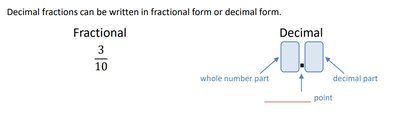
This question tests your ability to write a decimal as a fraction by using place value and simplifying if possible.
Key Terms and Formulas:
Decimal: A number with a fractional part separated by a decimal point.
Fraction: Write the decimal as a fraction with the appropriate power of 10 in the denominator, then reduce.
Step-by-Step Guidance
Count the number of decimal places in the decimal number.
Write the decimal as a fraction with the decimal part as the numerator and a denominator of 1 followed by as many zeros as there are decimal places.
Simplify the fraction by dividing numerator and denominator by their greatest common factor.
Try solving on your own before revealing the answer!
Q6. How do you convert a decimal to a percent?
Background
Topic: Decimals and Percents
This question checks your understanding of how to express a decimal as a percent by moving the decimal point and adding the percent symbol.
Key Terms and Formulas:
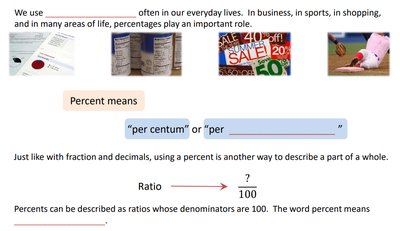
Percent: Means "per hundred" or "out of 100"
To convert a decimal to a percent: Move the decimal point two places to the right and add the % symbol.
Step-by-Step Guidance
Identify the decimal number you want to convert.
Move the decimal point two places to the right.
Write the new number and add the percent symbol (%) at the end.
Try solving on your own before revealing the answer!
Q7. How do you evaluate exponents?
Background
Topic: Exponents
This question tests your understanding of how to evaluate expressions with exponents, including positive and negative bases and the rules for even and odd exponents.
Key Terms and Formulas:
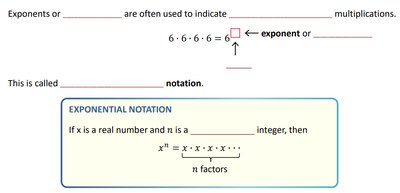
Exponent: The number that tells how many times to multiply the base by itself.
Base: The number being multiplied.
General formula: (n factors)
Step-by-Step Guidance
Identify the base and the exponent in the expression.
Multiply the base by itself as many times as indicated by the exponent.
If the base is negative, consider whether the exponent is even or odd to determine the sign of the result.
Try solving on your own before revealing the answer!
