 Back
BackGuided Study Notes: Beginning and Intermediate Algebra Essentials
Study Guide - Smart Notes
 Tailored notes based on your materials, expanded with key definitions, examples, and context.
Q1. What is the Real Number System and how are numbers classified within it?
Background
Topic: Real Number System
This question is about understanding the different types of numbers in mathematics and how they are grouped. This is foundational for algebra and higher-level math.
Key Terms:
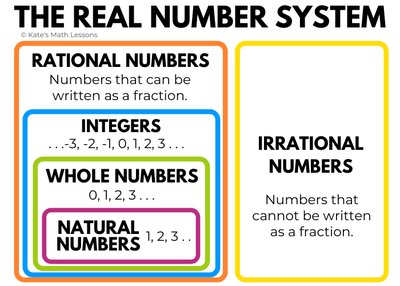
Natural Numbers: Counting numbers starting from 1 (1, 2, 3, ...).
Whole Numbers: Natural numbers plus zero (0, 1, 2, 3, ...).
Integers: Whole numbers and their negatives (..., -2, -1, 0, 1, 2, ...).
Rational Numbers: Numbers that can be written as a fraction (including integers, terminating and repeating decimals).
Irrational Numbers: Numbers that cannot be written as a fraction (like or ).
Step-by-Step Guidance
Start by identifying if a number can be written as a fraction. If yes, it is rational; if not, it is irrational.
Check if the number is a whole number, integer, or natural number by seeing if it fits those definitions.
Remember that all natural numbers are whole numbers, all whole numbers are integers, and all integers are rational numbers.
Try solving on your own before revealing the answer!
Q2. How do you add integers with the same sign?
Background
Topic: Integer Addition (Same Sign)
This question tests your understanding of how to add two positive or two negative integers.
Key Terms and Rules:
Absolute Value: The distance a number is from zero on the number line (always positive).
Sign: Whether a number is positive (+) or negative (−).
Step-by-Step Guidance
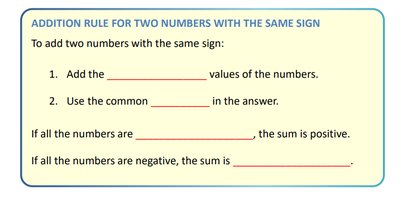
Add the absolute values of the numbers (ignore the signs for this step).
Use the common sign (either positive or negative) for the answer.
If both numbers are positive, the sum is positive. If both are negative, the sum is negative.
Try solving on your own before revealing the answer!
Q3. How do you add integers with different signs?
Background
Topic: Integer Addition (Different Signs)
This question is about adding a positive and a negative integer, or vice versa.
Key Terms and Rules:
Absolute Value
Difference
Sign of the Larger Absolute Value
Step-by-Step Guidance
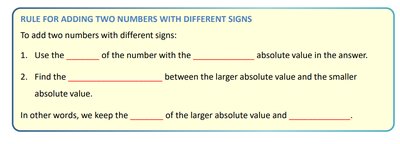
Find the absolute values of both numbers.
Subtract the smaller absolute value from the larger absolute value.
The sign of the answer is the same as the sign of the number with the larger absolute value.
Try solving on your own before revealing the answer!
Q4. How do you subtract signed numbers (integers)?
Background
Topic: Subtracting Integers
This question is about the rules for subtracting positive and negative numbers.
Key Terms and Rules:
Keep-Change-Change Rule: Keep the first number, change the subtraction sign to addition, and change the sign of the second number.
Step-by-Step Guidance
Keep the first number as it is.
Change the subtraction sign to addition.
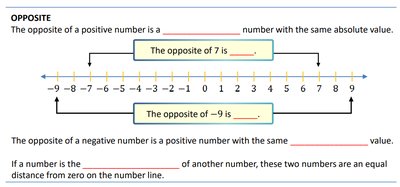
Change the sign of the second number (take the opposite).
Add the two numbers using the rules for adding integers.
Try solving on your own before revealing the answer!
Q5. How do you add and subtract decimals?
Background
Topic: Adding and Subtracting Decimals
This question is about lining up decimal points and performing addition or subtraction.
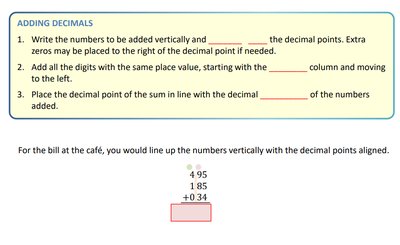
Key Steps:
Align the decimal points vertically.
Add zeros as placeholders if needed.
Add or subtract as with whole numbers, keeping the decimal point in line.
Step-by-Step Guidance
Write the numbers so the decimal points are lined up vertically.
Add zeros to the right if necessary to make the numbers the same length.
Add or subtract each column, starting from the rightmost digit.
Place the decimal point in the answer directly below the other decimal points.
Try solving on your own before revealing the answer!
Q6. How do you multiply and divide integers?
Background
Topic: Multiplying and Dividing Integers
This question is about determining the sign of the product or quotient and then performing the operation.
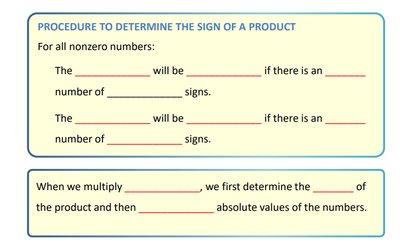
Key Rules:
If the signs are the same, the answer is positive.
If the signs are different, the answer is negative.
Step-by-Step Guidance
Count the number of negative signs in the problem.
If the number of negative signs is even, the answer is positive; if odd, the answer is negative.
Multiply or divide the absolute values of the numbers.
Try solving on your own before revealing the answer!
Q7. How do you simplify fractions and find equivalent fractions?
Background
Topic: Simplifying and Building Equivalent Fractions
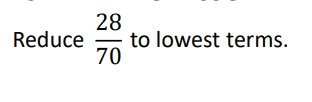
This question is about reducing fractions to lowest terms and creating equivalent fractions by multiplying or dividing by the same number.
Key Terms and Formulas:
Greatest Common Factor (GCF): The largest number that divides both the numerator and denominator.
Equivalent Fractions: Fractions that represent the same value.
Step-by-Step Guidance
Find the GCF of the numerator and denominator.
Divide both the numerator and denominator by the GCF.
Write the simplified fraction.
Try solving on your own before revealing the answer!
Q8. How do you find the Least Common Denominator (LCD) of two fractions?
Background
Topic: Least Common Denominator (LCD)
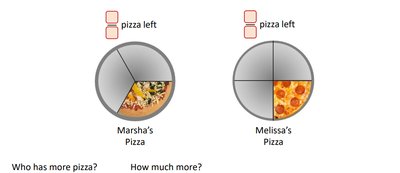
This question is about finding the smallest common multiple of two denominators, which is useful for adding or subtracting fractions.
Key Steps:
List the multiples of each denominator.
Find the smallest multiple that both denominators share.
Step-by-Step Guidance
Write the denominators of the two fractions.
List the first few multiples of each denominator.
Identify the smallest multiple that appears in both lists.
Try solving on your own before revealing the answer!
