 Back
BackGuided Study Notes: Operations with Integers and Decimals
Study Guide - Smart Notes
 Tailored notes based on your materials, expanded with key definitions, examples, and context.
Q1. What are the main categories of the real number system?
Background
Topic: Real Number System
This question is about understanding the classification of numbers, including rational, irrational, integers, whole numbers, and natural numbers.
Key Terms:
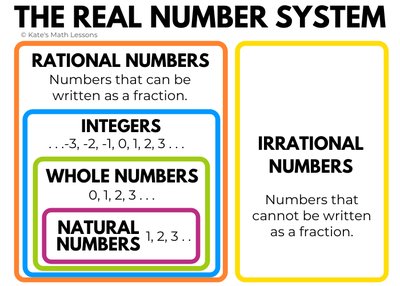
Natural Numbers: Counting numbers starting from 1 (1, 2, 3, ...).
Whole Numbers: Natural numbers plus zero (0, 1, 2, 3, ...).
Integers: Whole numbers and their negatives (..., -2, -1, 0, 1, 2, ...).
Rational Numbers: Numbers that can be written as a fraction.
Irrational Numbers: Numbers that cannot be written as a fraction.
Step-by-Step Guidance
Review the definitions of each category (natural, whole, integer, rational, irrational).
Notice how each set is nested within the next (natural ⊆ whole ⊆ integer ⊆ rational).
Understand that irrational numbers are separate from rational numbers and cannot be written as fractions.
Try solving on your own before revealing the answer!
Q2. How do you add two positive integers, such as ?
Background
Topic: Adding Integers with the Same Sign
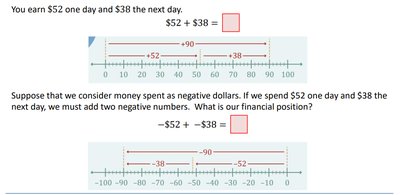
This question tests your ability to add two positive numbers using a number line.
Key Terms and Concepts:
Integer: A whole number, positive or negative, including zero.
Number Line: A visual representation to show addition or subtraction.
Step-by-Step Guidance
Start at the first number on the number line (52).
Move to the right by the value of the second number (38 units).
The point you land on is the sum of the two numbers.
Try solving on your own before revealing the answer!
Q3. What is the rule for adding two numbers with the same sign?
Background
Topic: Addition Rules for Integers
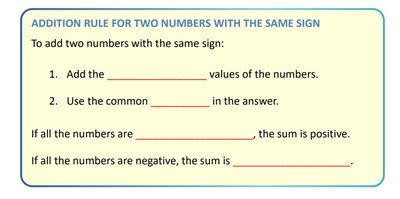
This question is about the procedure for adding two numbers that are both positive or both negative.
Key Terms:
Absolute Value: The distance a number is from zero on the number line, always positive.
Sign: Indicates whether a number is positive or negative.
Step-by-Step Guidance
Add the absolute values of the numbers.
Use the common sign (either positive or negative) in the answer.
If both numbers are positive, the sum is positive; if both are negative, the sum is negative.
Try solving on your own before revealing the answer!
Q4. How do you add two numbers with the same sign on a number line?
Background
Topic: Visualizing Integer Addition
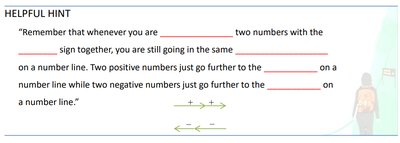
This question helps you understand how adding two numbers with the same sign affects movement on a number line.
Key Concepts:
Adding two positive numbers moves you to the right.
Adding two negative numbers moves you to the left.
Step-by-Step Guidance
Identify the direction you move on the number line based on the sign (right for positive, left for negative).
Combine the movements to see where you end up.
Try solving on your own before revealing the answer!
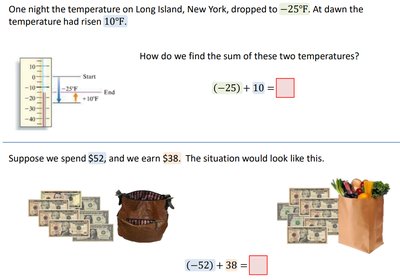
Q5. How do you add integers with different signs, such as ?
Background
Topic: Adding Integers with Different Signs
This question tests your understanding of how to add a negative and a positive integer.
Key Terms and Concepts:
Absolute Value
Difference
Step-by-Step Guidance
Find the absolute values of both numbers.
Subtract the smaller absolute value from the larger absolute value.
The sign of the answer is the same as the number with the larger absolute value.
Try solving on your own before revealing the answer!
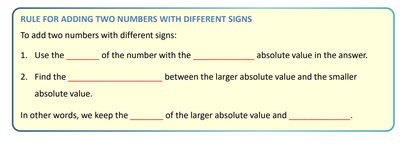
Q6. What is the rule for adding two numbers with different signs?
Background
Topic: Addition of Integers with Different Signs
This question is about the procedure for adding a positive and a negative number.
Key Steps:
Use the sign of the number with the larger absolute value in the answer.
Find the difference between the larger and smaller absolute values.
Try solving on your own before revealing the answer!
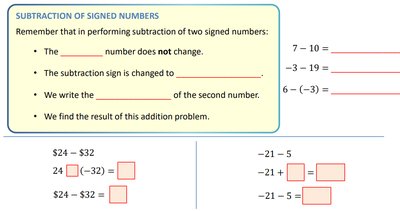
Q7. How do you subtract signed numbers, such as or ?
Background
Topic: Subtraction of Signed Numbers
This question tests your ability to convert subtraction into addition and apply the rules for signed numbers.
Key Steps:
Keep the first number the same.
Change the subtraction sign to addition.
Take the opposite (additive inverse) of the second number.
Add using the rules for addition of integers.
Try solving on your own before revealing the answer!
Q8. How do you add and subtract decimals, such as ?
Background
Topic: Adding and Subtracting Decimals
This question is about aligning decimal points and performing addition or subtraction with decimals.

Key Steps:
Write the numbers vertically, aligning the decimal points.
Add zeros to the right if needed to match decimal places.
Add or subtract each column, starting from the rightmost digit.
Place the decimal point in the answer directly below the other decimal points.
Try solving on your own before revealing the answer!
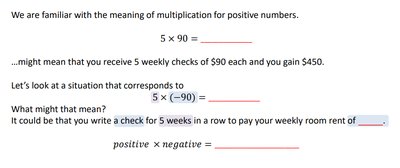
Q9. How do you multiply and divide integers, and determine the sign of the result?
Background
Topic: Multiplying and Dividing Integers
This question is about the rules for determining the sign of a product or quotient when multiplying or dividing integers.
Key Steps:
If there is an even number of negative signs, the result is positive.
If there is an odd number of negative signs, the result is negative.
Multiply or divide the absolute values of the numbers.
Try solving on your own before revealing the answer!
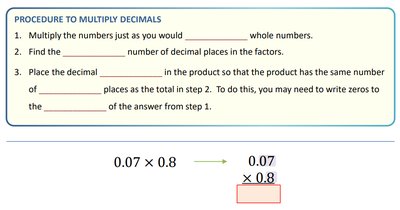
Q10. How do you multiply decimals, such as ?
Background
Topic: Multiplying Decimals
This question is about multiplying decimals and placing the decimal point correctly in the product.
Key Steps:
Multiply the numbers as if they were whole numbers.
Count the total number of decimal places in both factors.
Place the decimal point in the product so that it has the same number of decimal places as the total from step 2.
Try solving on your own before revealing the answer!
