Back
BackIntermediate Algebra Course Weekly Outline and Key Topics
Study Guide - Smart Notes
 Tailored notes based on your materials, expanded with key definitions, examples, and context.
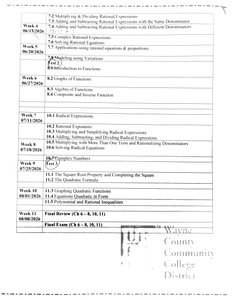
Course Outline: Intermediate Algebra
Overview
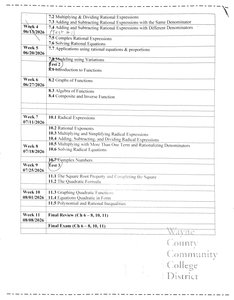
This syllabus provides a week-by-week breakdown of topics covered in an intermediate algebra course. The topics align with foundational concepts in algebra, including rational expressions, functions, radicals, quadratic equations, and more. Below is a structured summary of the main topics and subtopics, with definitions, examples, and key points for each area.
Rational Expressions
Multiplying and Dividing Rational Expressions
Rational expressions are fractions where the numerator and denominator are polynomials. Multiplying and dividing these expressions require factoring and simplifying.
Key Point 1: To multiply rational expressions, multiply the numerators together and the denominators together, then simplify.
Key Point 2: To divide, multiply by the reciprocal of the divisor.
Example:
Adding and Subtracting Rational Expressions
Adding or subtracting rational expressions requires a common denominator.
Key Point 1: If denominators are the same, add or subtract numerators directly.
Key Point 2: If denominators differ, find the least common denominator (LCD).
Example:
Solving Rational Equations
Solving and Applying Rational Equations
Rational equations contain rational expressions. Solutions often require clearing denominators by multiplying both sides by the LCD.
Key Point 1: Always check for extraneous solutions caused by restrictions on the variable.
Example: Solve
Functions
Introduction to Functions
A function is a relation where each input has exactly one output. Functions can be represented as equations, tables, or graphs.
Key Point 1: The domain is the set of all possible input values.
Key Point 2: The range is the set of all possible output values.
Example:
Graphs of Functions
Graphing functions helps visualize their behavior and identify key features such as intercepts and asymptotes.
Key Point 1: Plot points by substituting values for and finding corresponding values.
Key Point 2: Identify intercepts by setting or .
Radical Expressions
Radical Expressions and Equations
Radical expressions involve roots, such as square roots or cube roots. Simplifying and solving radical equations often requires isolating the radical and then squaring both sides.
Key Point 1:
Key Point 2: Always check for extraneous solutions after solving.
Example: Solve
Quadratic Equations
Solving Quadratic Equations
Quadratic equations are equations of the form . They can be solved by factoring, completing the square, or using the quadratic formula.
Key Point 1: The quadratic formula is
Key Point 2: The discriminant determines the number and type of solutions.
Example: Solve by factoring:
Graphing Quadratic Functions
The graph of a quadratic function is a parabola. The vertex and axis of symmetry are key features.
Key Point 1: The vertex is at
Key Point 2: The axis of symmetry is the vertical line through the vertex.
Summary Table: Weekly Topics
Week | Main Topics |
|---|---|
4 | Multiplying, Dividing, Adding, and Subtracting Rational Expressions |
5 | Solving Rational Equations, Introduction to Functions |
6 | Graphs of Functions, Composite and Inverse Functions |
7 | Radical Expressions |
8 | Operations with Radical Expressions, Rationalizing Denominators |
9 | Solving Radical Equations, Quadratic Equations |
10 | Quadratic Formula, Graphing Quadratic Functions |
11 | Review and Final Exam |