 Back
BackMath 102: Comprehensive Study Guide and Tentative Schedule (Spring 2026)
Study Guide - Smart Notes
 Tailored notes based on your materials, expanded with key definitions, examples, and context.
Course Overview
This study guide summarizes the main topics, learning objectives, and schedule for a beginning-intermediate algebra course (Math 102), based on the provided tentative schedule for Spring 2026. The course covers foundational algebraic concepts, equations, functions, graphing, and introductory topics in quadratic equations and transformations.
Course Schedule and Main Topics
Week 1: Operations on Real Numbers and Algebraic Expressions
Prime and Composite Numbers: Recognize and classify numbers as prime or composite.
Prime Factorization: Express numbers as products of prime factors.
Least Common Multiple (LCM): Find the LCM of two or more numbers.
Equivalent Fractions: Write and simplify fractions to lowest terms.
Absolute Value: Evaluate the absolute value of numbers.
Operations with Integers: Add, subtract, multiply, and divide integers; determine additive inverses.
Roots: Evaluate square roots of perfect squares and cube roots.
Simplifying Radicals: Use the product property to simplify radical expressions.
Week 2: Algebraic Expressions and Exponents
Evaluating Expressions: Substitute values and simplify algebraic expressions.
Order of Operations: Apply the correct sequence of operations (PEMDAS).
Exponents: Simplify expressions using the product and power rules for exponents.
Multiplying Monomials: Multiply monomials and apply exponent rules.
Week 3: Linear Equations and Inequalities in One Variable
Solving Linear Equations: Use the addition and multiplication properties of equality to solve equations.
Checking Solutions: Determine if a number is a solution to an equation.
Week 4: Exponents and Polynomials
Monomials and Polynomials: Define and determine the degree of monomials and polynomials.
Combining Like Terms: Simplify polynomials by combining like terms.
Polynomial Operations: Multiply polynomials using distributive property and FOIL method.
Week 5: Factoring Polynomials
Greatest Common Factor (GCF): Find and factor out the GCF in polynomials.
Factoring Trinomials: Factor trinomials of the form .
Special Products: Factor perfect square trinomials and the difference of squares.
Complete Factoring: Factor polynomials completely.
Week 7: Graphs, Relations, and Functions
Graph Symmetry: Identify x- and y-symmetry, even and odd functions from graphs and equations.
Graph Analysis: Determine intervals of increase, decrease, and constancy; locate maxima and minima.
Graphing Equations: Use the point-plotting method and identify intercepts.
Relations: Understand relations, domain, and range; graph relations defined by equations.
Six Main Functions: Identity, squared, cubed, square root, absolute value, and reciprocal functions.
Week 9: Introduction to Functions
Definition of Function: Determine if a relation (map, ordered pairs, equation, or graph) is a function.
Evaluating Functions: Find the value and domain of a function.
Applications: Apply functions to real-world problems.
Composite and Operations on Functions: Evaluate composite functions and perform operations on functions.
Week 10: Linear Functions and Graphing
Slope and Graphing: Find the slope and graph lines given a point and the slope.
Equation of a Line: Write equations in form; find equations given points or conditions (parallel/perpendicular).
Horizontal and Vertical Lines: Identify and write equations for these lines.
Line Relationships: Determine if lines are parallel, perpendicular, or neither.
Week 12: Transformations of Functions
Shifts: Graph functions using vertical and horizontal shifts.
Compressions and Stretches: Apply vertical compressions and stretches to function graphs.
Reflections: Reflect functions about the x-axis.
Week 13: Quadratic Functions and Graphing
Graphing Quadratics: Graph functions of the form .
Key Features: Identify axis of symmetry, vertex, maxima/minima, domain, range, intercepts, and intervals of increase/decrease.
Applications: Solve maximum or minimum word problems.
Week 14: Solving Quadratic Equations
Factoring: Solve quadratic equations by factoring.
Quadratic Formula: Use the quadratic formula to find solutions.
No Solution Cases: Understand what it means for a quadratic equation to have no real solution (in terms of the graph).
Exam Schedule
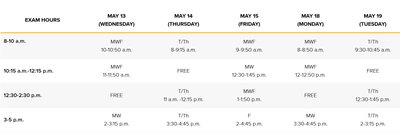
The final exam schedule is provided below. Please refer to the table for specific exam times based on your class meeting days and times.
Exam Hours | May 13 (Wednesday) | May 14 (Thursday) | May 15 (Friday) | May 18 (Monday) | May 19 (Tuesday) |
|---|---|---|---|---|---|
8:00 a.m. | MW 10:30-50 a.m. | TR 8:55 a.m. | MWF 9:50 a.m. | MWF 8:50 a.m. | TR 9:30-10:45 a.m. |
10:15 a.m.-12:15 p.m. | TR 11:50 a.m. | FREE | MWF 11:00 a.m. | TR 12:50 p.m. | FREE |
12:30-2:30 p.m. | FREE | TR 11 a.m.-12:15 p.m. | MWF 1:00 p.m. | FREE | TR 12:30-1:45 p.m. |
3-5 p.m. | MW 2:35 p.m. | TR 3:30-4:45 p.m. | F 2:45 p.m. | MWF 3:30-4:45 p.m. | TR 2:35 p.m. |
Additional Info
Written homework and quizzes are due as indicated in the schedule.
Review sheets are provided before each test and the final exam.
Spring Break is scheduled for Week 8 (no classes).
