Back

Allosteric Enzyme Conformations definitions

Control buttons has been changed to "navigation" mode.
1/15
  • Allosteric Enzyme

    Protein with multiple conformations, each displaying distinct catalytic activity and substrate affinity, often regulated by effectors.
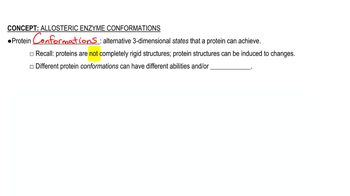
  • Conformation

    Three-dimensional structural state of a protein, determining its functional properties and substrate binding efficiency.
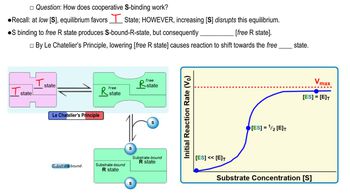
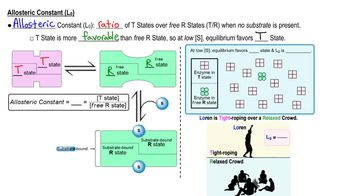
  • T State

    Catalytically inactive form with low substrate affinity, favored at low substrate concentrations and represented by a tense structure.
  • R State

    Catalytically active form with high substrate affinity, characterized by a relaxed structure and efficient substrate binding.
  • Active Site

    Region within an enzyme where substrate molecules fit and undergo chemical transformation, its accessibility varies by conformation.
  • Allosteric Constant

    Ratio of the concentration of tense states to free relaxed states in absence of substrate, indicating equilibrium preference.
  • Sigmoidal Kinetics

    S-shaped curve on enzyme activity plots, reflecting cooperative substrate binding and deviation from Michaelis-Menten behavior.
  • Positive Cooperativity

    Phenomenon where binding of one substrate molecule enhances the likelihood of additional substrate molecules binding.
  • Michaelis-Menten Kinetics

    Enzyme activity pattern showing a rectangular hyperbola, typical for non-cooperative enzymes with a single active site.
  • Concerted Model

    Theory proposing all subunits of an enzyme switch conformations simultaneously, explaining cooperative binding and sigmoidal kinetics.
  • Sequential Model

    Theory suggesting subunits change conformation individually upon substrate binding, allowing for intermediate states and cooperativity.
  • Allosteric Effector

    Molecule that binds to an enzyme at a site other than the active site, modulating its activity and conformation.
  • Subunit

    Individual protein component within a multi-unit enzyme, each capable of adopting different conformations and contributing to overall function.
  • Enzyme-Substrate Complex

    Association formed when substrate binds to the enzyme's active site, often representing the catalytically active relaxed state.
  • Le Chatelier's Principle

    Concept describing how equilibrium shifts to counteract changes, such as substrate binding altering enzyme state distributions.