Back

Allosteric Enzyme Conformations quiz

Control buttons has been changed to "navigation" mode.
1/15
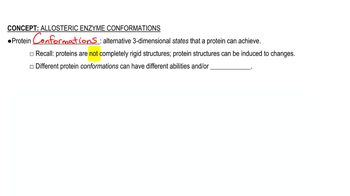
  • What are the two conformations of allosteric enzymes called?

    The two conformations are the T (tense) state and the R (relaxed) state.
  • Which allosteric enzyme state is catalytically inactive and has low substrate affinity?

    The T (tense) state is catalytically inactive and binds substrate inefficiently.
  • What is the substrate affinity of the R state in allosteric enzymes?

    The R (relaxed) state has high substrate affinity and binds substrates efficiently.
  • How does the T state of an allosteric enzyme affect substrate binding?

    The T state binds substrates very inefficiently due to its tense conformation.
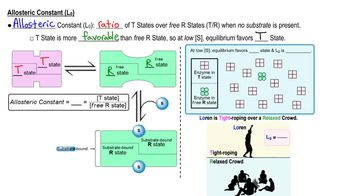
  • What is the allosteric constant (l naught) defined as?

    The allosteric constant l naught is the ratio of the concentration of T states to the concentration of free R states in the absence of substrate.
  • At low substrate concentrations, which state is favored in allosteric enzymes?

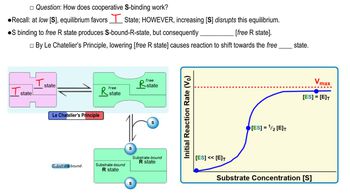
    The T state is thermodynamically favored at low substrate concentrations.
  • Does the allosteric constant l naught involve substrate-bound R states?

    No, l naught is the ratio of T states to free R states, not substrate-bound R states.
  • What type of kinetics do allosteric enzymes display on an enzyme kinetics plot?

    Allosteric enzymes display sigmoidal (S-shaped) kinetics on enzyme kinetics plots.
  • What does sigmoidal kinetics in allosteric enzymes suggest about substrate binding?

    Sigmoidal kinetics suggest positive cooperativity, where binding of one substrate facilitates binding of others.
  • How does substrate binding to the free R state affect the equilibrium between T and R states?

    Binding substrate to the free R state decreases its concentration, causing the equilibrium to shift towards producing more R state.
  • What is positive cooperativity in allosteric enzymes?

    Positive cooperativity is when binding of one substrate molecule makes it easier for additional substrate molecules to bind.
  • How does increasing the allosteric constant l naught affect the enzyme kinetics curve?

    A higher l naught makes the curve more sigmoidal, indicating greater cooperativity.
  • What happens to the enzyme kinetics curve when l naught is low?

    The curve becomes less sigmoidal and more closely resembles Michaelis-Menten kinetics.
  • Name the two models that explain sigmoidal kinetics in allosteric enzymes.

    The concerted (MWC) model and the sequential (KNF) model explain sigmoidal kinetics.
  • What role do allosteric effectors play in the concerted and sequential models?

    Allosteric effectors influence enzyme activity in both the concerted and sequential models.