Back

Amino Acid Oxidation 1 definitions

Control buttons has been changed to "navigation" mode.
1/15
  • Amino Acid Oxidation

    Cellular process using amino acid carbon skeletons for energy, requiring nitrogen removal to avoid toxicity.
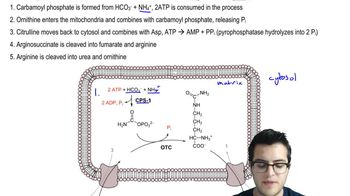
  • Urea Cycle

    Liver pathway converting nitrogen from amino acids into a less toxic compound, preventing ammonia accumulation.
  • Mitochondrial Matrix

    Intracellular compartment where the initial steps of nitrogen removal and urea formation occur.
  • Carbamoyl Phosphate

    Molecule formed from bicarbonate and ammonium, serving as a key intermediate in nitrogen disposal.
  • Carbamoyl Phosphate Synthetase

    Enzyme catalyzing the formation of a crucial nitrogen-containing intermediate using ATP.
  • Ornithine

    A cycle participant that shuttles between compartments, combining with intermediates to facilitate nitrogen removal.
  • Citrulline

    Intermediate formed in the mitochondria, exported to the cytosol for further reactions in nitrogen metabolism.
  • Aspartate

    Amino acid that reacts with intermediates in the cytosol, contributing a nitrogen atom to the cycle.
  • Argininosuccinate

    Compound produced from citrulline and aspartate, later split to release fumarate and arginine.
  • Fumarate

    Molecule released during the cycle, linking nitrogen metabolism to energy production pathways.
  • Arginine

    Intermediate that releases the final nitrogen product, regenerating a cycle participant.
  • Urea

    Non-toxic compound excreted by the body, formed from nitrogen atoms to prevent cellular toxicity.
  • ATP

    Energy currency required at multiple steps to drive the conversion of nitrogen-containing molecules.
  • Pyrophosphate

    Byproduct of ATP breakdown during intermediate formation, later hydrolyzed to inorganic phosphate.
  • AMP

    Molecule temporarily attached to intermediates during the cycle, released after aspartate addition.