Back

Approximating Protein Mass definitions

Control buttons has been changed to "navigation" mode.
1/15
  • Amino Acid

    Building block of proteins, each with a distinct mass except for two isomeric exceptions.
  • Leucine

    One of two amino acids sharing identical mass due to structural isomerism.
  • Isoleucine

    Isomer of another amino acid, possessing the same chemical formula and mass.
  • Isomer

    Molecule sharing a chemical formula with another but differing in structure.
  • Protein

    Large biomolecule composed of hundreds to thousands of amino acid residues.
  • Peptide Bond

    Linkage formed between amino acids, resulting in the loss of a water molecule.
  • Dehydration Synthesis

    Reaction joining amino acids, characterized by the removal of water.
  • Residue

    Amino acid unit within a protein, reflecting mass after peptide bond formation.
  • Molecular Weight

    Mass of a molecule expressed in grams per mole, crucial for protein calculations.
  • Relative Molecular Weight

    Alternate term for molecular weight, often abbreviated as m r.
  • Alpha Amino Acid

    Type of amino acid with an average mass used in protein mass approximations.
  • Water Molecule

    Compound lost during peptide bond formation, impacting protein mass.
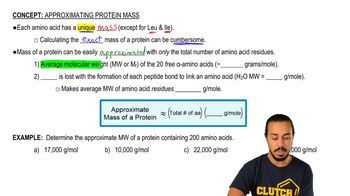
  • Approximate Mass

    Estimated value for protein mass, calculated using residue count and average residue weight.
  • Grams per Mole

    Unit measuring molecular weight, essential for quantifying protein mass.
  • Equation

    Mathematical expression used to estimate protein mass based on residue number and average weight.