Back

Lipids definitions

Control buttons has been changed to "navigation" mode.
1/15
  • Lipids

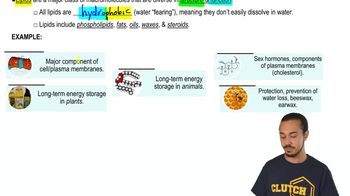
    Diverse macromolecules found in all living cells, characterized by their hydrophobic nature and varied structures and functions.
  • Phospholipids

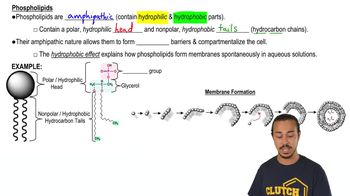
    Amphipathic molecules with polar heads and nonpolar tails, forming the structural basis of cell membranes.
  • Fats

    Animal-derived lipids used for long-term energy storage, typically solid at room temperature.
  • Oils

    Plant-derived lipids serving as long-term energy reserves, usually liquid at room temperature.
  • Waxes

    Hydrophobic substances providing protection and preventing water loss, found in beeswax and earwax.
  • Steroids

    Structurally diverse lipids including sex hormones and cholesterol, important for signaling and membrane structure.
  • Cholesterol

    A steroid component of cell membranes, contributing to membrane rigidity and fluidity.
  • Hydrophobic

    Describes molecules that repel water and do not mix or dissolve well in aqueous environments.
  • Hydrophilic

    Describes molecules attracted to water, often forming the polar head of phospholipids.
  • Amphipathic

    Characteristic of molecules containing both hydrophilic and hydrophobic regions, enabling membrane formation.
  • Phospholipid Bilayer

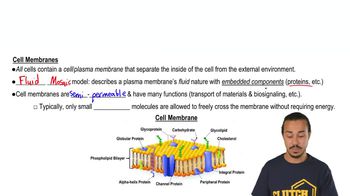
    Double-layered structure in cell membranes, composed of phospholipids with fluid and dynamic properties.
  • Fluid Mosaic Model

    Concept describing cell membranes as flexible structures with embedded proteins and assorted components.
  • Cell Membrane

    Barrier separating the cell's interior from its exterior, primarily composed of a phospholipid bilayer.
  • Hydrocarbon Chains

    Nonpolar tails of phospholipids, consisting of long sequences of hydrogen and carbon atoms.
  • Selective Permeability

    Property of membranes allowing certain molecules, like small nonpolar substances, to cross freely.