Back

Calculating Km quiz

Control buttons has been changed to "navigation" mode.
1/15
  • What is the Michaelis constant (Km) in enzyme kinetics?

    Km is the substrate concentration at which the initial reaction velocity is half of the maximum velocity (Vmax).
  • How can Km be calculated using the Michaelis-Menten equation?

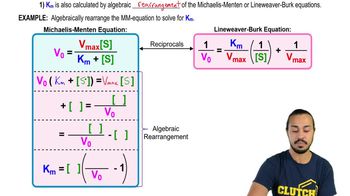
    Km can be isolated by algebraically rearranging the Michaelis-Menten equation to solve for Km in terms of Vmax, initial velocity, and substrate concentration.
  • What is the simplified expression for Km after rearranging the Michaelis-Menten equation?

    The simplified expression is Km = [S] * (Vmax / Vā‚€ - 1), where [S] is substrate concentration and Vā‚€ is initial velocity.
  • At what substrate concentration does Km equal the substrate concentration?

    Km equals the substrate concentration when the initial reaction velocity is half of Vmax.
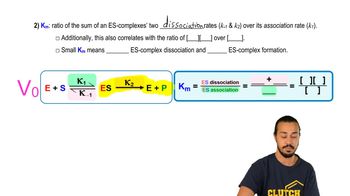
  • What is the second method for calculating Km?

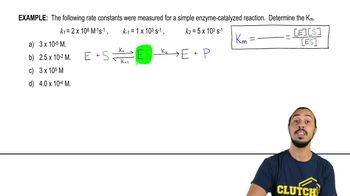
    The second method uses rate constants: Km = (k-1 + k2) / k1, where k-1 and k2 are dissociation rate constants and k1 is the association rate constant.
  • What do k-1, k2, and k1 represent in the context of enzyme kinetics?

    k-1 is the rate constant for dissociation of the enzyme-substrate complex back to enzyme and substrate, k2 is for dissociation to enzyme and product, and k1 is for association of enzyme and substrate.
  • How does the ratio of free enzyme and substrate to enzyme-substrate complex relate to Km?

    Km correlates with the ratio ([E][S]) / [ES], representing the balance between dissociation and association of the enzyme-substrate complex.
  • What does a small Km value indicate about enzyme-substrate affinity?

    A small Km value indicates high affinity between enzyme and substrate, meaning more enzyme-substrate complex is formed and less is dissociated.
  • What does a large Km value suggest about the enzyme-substrate complex?

    A large Km value suggests more dissociation of the enzyme-substrate complex, indicating lower affinity between enzyme and substrate.
  • Why is k-2 ignored in the calculation of Km at the beginning of the reaction?

    k-2 is ignored because, at the very beginning of the reaction, the reverse reaction from product to enzyme-substrate complex is negligible.
  • How are the Michaelis-Menten and Lineweaver-Burk equations related?

    They are reciprocals of each other and can be algebraically converted from one form to the other.
  • What is the significance of Vmax in the calculation of Km?

    Vmax is the maximum reaction velocity, and Km is calculated at the substrate concentration where the reaction velocity is half of Vmax.
  • What does the numerator (k-1 + k2) in the rate constant method for Km represent?

    It represents the total rate at which the enzyme-substrate complex dissociates, either back to enzyme and substrate or forward to enzyme and product.
  • What does the denominator (k1) in the rate constant method for Km represent?

    It represents the rate at which the enzyme and substrate associate to form the enzyme-substrate complex.
  • How does the concentration of free enzyme and substrate affect the value of Km?

    Higher concentrations of free enzyme and substrate relative to the enzyme-substrate complex increase Km, indicating lower affinity.