Back

Cyclic Monosaccharides definitions

Control buttons has been changed to "navigation" mode.
1/15
  • Cyclic Monosaccharide

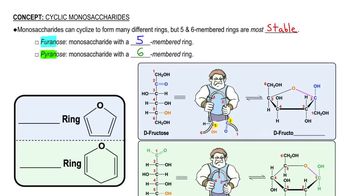
    Predominant sugar form in biological solutions, featuring a ring structure with at least five atoms, often more stable than linear forms.
  • Furanose

    Five-membered ring structure in sugars, composed of four carbon atoms and one oxygen atom, resembling the furan ring.
  • Pyranose

    Six-membered ring structure in sugars, containing five carbon atoms and one oxygen atom, modeled after the pyran ring.
  • Fischer Projection

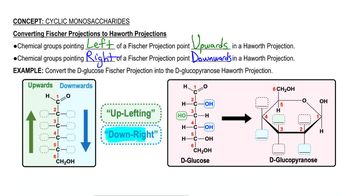
    Two-dimensional representation of a sugar's linear form, with vertical carbon chains and groups oriented left or right.
  • Haworth Projection

    Three-dimensional depiction of a cyclic sugar, using thick lines for bonds coming out of the page and thin lines for bonds receding.
  • Anomeric Carbon

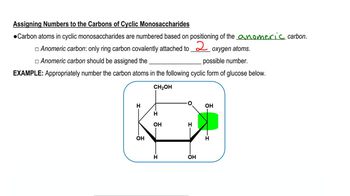
    Ring carbon atom directly bonded to two oxygen atoms, assigned the lowest number during cyclic sugar numbering.
  • Ring Oxygen

    Oxygen atom incorporated within the sugar ring, distinguishing furanose and pyranose structures from purely carbon rings.
  • Hydroxyl Group

    Functional group attached to sugar carbons, orientation determines up or down positioning in Haworth projections.
  • Planarity

    False impression of flatness in ring structures due to projection drawings, despite actual tetrahedral geometry of carbons.
  • Tetrahedral Geometry

    Spatial arrangement of carbon atoms in sugars, causing rings to be non-planar and three-dimensional.
  • Numbering

    Assignment of sequential values to ring carbons, starting with the anomeric carbon as number one in cyclic sugars.
  • D-Glucose

    Common monosaccharide that forms both linear and cyclic structures, often depicted in Fischer and Haworth projections.
  • D-Fructose

    Monosaccharide capable of cyclizing into furanose rings, with a ketone group participating in ring formation.
  • Sugar Ring

    Closed-loop structure formed by monosaccharides, typically five or six members, including at least one oxygen atom.
  • Carbonyl Group

    Functional group (aldehyde or ketone) in linear sugars, involved in cyclization to form ring structures.