Back

Cyclic Monosaccharides quiz

Control buttons has been changed to "navigation" mode.
1/15
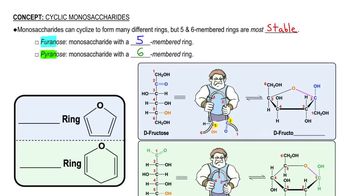
  • What are the two most common types of cyclic monosaccharides found in biological solutions?

    The two most common types are furanoses (5-membered rings) and pyranoses (6-membered rings).
  • How many carbons and oxygens are present in the ring structure of a furanose?

    A furanose ring contains 4 carbons and 1 oxygen atom.
  • What is the composition of a pyranose ring in terms of carbon and oxygen atoms?

    A pyranose ring has 5 carbons and 1 oxygen atom.
  • Why are 5- and 6-membered rings the most common forms of cyclic monosaccharides?

    They are the most stable ring sizes, making them predominant in biological systems.
  • What is the significance of the 'furan' and 'pyran' prefixes in furanoses and pyranoses?

    The prefixes refer to the resemblance of the sugar rings to the chemical structures of furan (5-membered) and pyran (6-membered).
  • What is the main difference in ring formation between D-fructose and D-glucose?

    D-fructose forms a furanose ring by the C5 hydroxyl reacting with the C2 ketone, while D-glucose forms a pyranose ring by the C5 hydroxyl reacting with the C1 aldehyde.
  • Do cyclic monosaccharides require enzymes to form their rings?

    No, cyclic monosaccharides can form their rings spontaneously without enzymes.
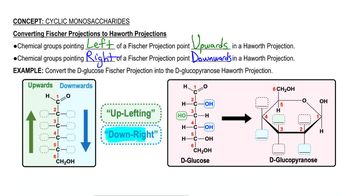
  • How do you convert a Fischer projection to a Haworth projection regarding group orientation?

    Groups pointing left in the Fischer projection go upwards in the Haworth projection, and groups pointing right go downwards.
  • What mnemonic can help remember the conversion from Fischer to Haworth projections?

    Use 'up lifting' for left-pointing groups (upwards) and 'down right' for right-pointing groups (downwards).
  • What is the purpose of Haworth projections in representing cyclic monosaccharides?

    Haworth projections provide a 3D representation of cyclic monosaccharides, showing bonds coming out of and going into the page.
  • How are bonds depicted in Haworth projections to indicate their spatial orientation?

    Thicker, darker lines represent bonds coming out of the page, while thinner, lighter lines represent bonds going into the page.
  • Where is the anomeric carbon typically located in a standard Haworth projection?

    The anomeric carbon is usually on the right side of the structure.
  • How is the anomeric carbon identified in a cyclic monosaccharide?

    It is the only carbon covalently attached to two oxygen atoms: one from the ring and one from a hydroxyl group.
  • What rule is used for numbering carbons in cyclic monosaccharides?

    The anomeric carbon is assigned the lowest number, typically carbon 1, and numbering proceeds sequentially around the ring.
  • Are cyclic monosaccharides planar as depicted in Haworth projections?

    No, they are not planar; the tetrahedral geometry of carbon atoms means the ring is not flat despite its appearance in Haworth projections.