Back

Differential Centrifugation quiz

Control buttons has been changed to "navigation" mode.
1/15
  • What is the purpose of centrifugation in protein purification?

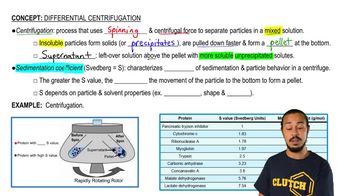
    Centrifugation separates proteins and cell components based on their sedimentation coefficients, allowing for isolation of specific particles.
  • What forms at the bottom of the centrifuge tube after spinning a sample?

    A pellet forms at the bottom, containing insoluble proteins or particles that have sedimented.
  • What is the supernatant in centrifugation?

    The supernatant is the liquid above the pellet, containing soluble proteins and unprecipitated solutes.
  • What does the sedimentation coefficient (s value) represent?

    The sedimentation coefficient characterizes the speed at which a particle sediments during centrifugation.
  • Which factors influence the sedimentation coefficient of a particle?

    The s value depends on the particle's density, shape, mass, and the properties of the solvent.
  • Does molecular weight alone determine the sedimentation coefficient?

    No, molecular weight is not the only factor; density and shape also significantly affect the s value.
  • What is differential centrifugation?

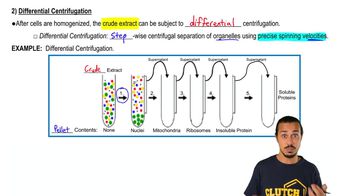
    Differential centrifugation is a stepwise process that separates cell components by spinning at precise velocities to pellet specific organelles.
  • What is typically pelleted during the first step of differential centrifugation?

    The nuclei are usually pelleted in the first step due to their higher sedimentation coefficient.
  • How are mitochondria isolated using differential centrifugation?

    After removing the nuclei, the supernatant is spun at a different velocity to pellet the mitochondria.
  • What happens to the supernatant after each centrifugation step?

    The supernatant is transferred to a new tube and can be spun again to isolate additional components.
  • How can ribosomes be separated from other cell components?

    Ribosomes are pelleted by spinning the supernatant at a specific velocity and duration after mitochondria have been removed.
  • Why might a researcher focus on either the pellet or the supernatant?

    Depending on the desired protein or component, a researcher may focus on the pellet (insoluble) or the supernatant (soluble).
  • What is the role of continued centrifugation in protein purification?

    Continued centrifugation is necessary to further purify the protein of interest by removing unwanted components.
  • How does the centrifugal force affect particles in a centrifuge?

    Centrifugal force pulls particles with higher s values to the bottom, forming a pellet, while others remain in the supernatant.
  • What is the significance of precise spinning velocities in differential centrifugation?

    Precise spinning velocities allow selective pelleting of specific organelles or proteins based on their sedimentation coefficients.