Back

DNA Sequencing 1 definitions

Control buttons has been changed to "navigation" mode.
1/15
  • DNA Polymerase

    Enzyme responsible for extending an existing nucleic acid strand using a template and nucleotide triphosphates.
  • RNA Primer

    Short nucleic acid sequence required to initiate DNA synthesis, providing a starting point for elongation.
  • Template Strand

    Nucleic acid sequence used to guide the order of base incorporation during DNA synthesis.
  • Deoxynucleotide Triphosphate

    Building block for DNA synthesis, providing both the nucleotide and energy for strand elongation.
  • Pyrophosphate

    Byproduct released during nucleotide incorporation, resulting from the cleavage of phosphate bonds.
  • Hydrogen Ion

    Small molecule released as a byproduct during DNA strand elongation.
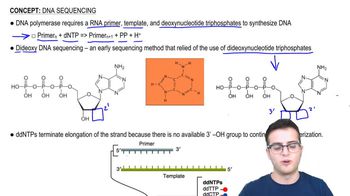
  • Dideoxynucleotide Triphosphate

    Modified nucleotide lacking a 3′ hydroxyl group, causing chain termination when incorporated.
  • 3′ Hydroxyl Group

    Functional group on the sugar backbone essential for attachment of the next nucleotide during DNA synthesis.
  • Gel Electrophoresis

    Technique used to separate DNA fragments by length, enabling sequence determination.
  • Primer Elongation

    Process of extending a nucleic acid strand from an initial primer using nucleotide triphosphates.
  • Nucleotide Incorporation

    Addition of a nucleotide to a growing DNA strand, guided by the template sequence.
  • Chain-Terminating Nucleotide

    Molecule that halts DNA synthesis by preventing further elongation of the strand.
  • Fragment Length

    Measurement of DNA strand size, used to deduce sequence information after separation.
  • Molecular Biology

    Field focused on understanding the molecular mechanisms underlying genetic information and its expression.
  • Genomics

    Discipline concerned with the sequencing, analysis, and interpretation of entire genetic material.