Back

DNA Sequencing 1 quiz

Control buttons has been changed to "navigation" mode.
1/15
  • What does DNA polymerase require to synthesize DNA?

    DNA polymerase requires an RNA primer, a template strand, and deoxynucleotide triphosphates to synthesize DNA.
  • Why is an RNA primer necessary for DNA polymerase?

    DNA polymerase cannot start synthesizing a new DNA strand on its own; it can only elongate an existing strand, which is provided by the RNA primer.
  • What is the role of the template strand in DNA synthesis?

    The template strand provides the complementary base sequence that guides DNA polymerase in synthesizing the new DNA strand.
  • What is released as a byproduct when DNA polymerase adds a nucleotide?

    Pyrophosphate and a hydrogen ion are released as byproducts when DNA polymerase adds a nucleotide.
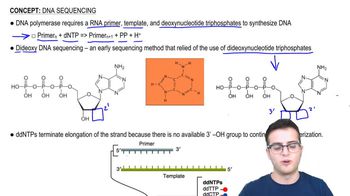
  • What is the key structural difference between deoxynucleotide and dideoxynucleotide triphosphates?

    Dideoxynucleotide triphosphates lack both the 2′ and 3′ hydroxyl groups, while deoxynucleotide triphosphates only lack the 2′ hydroxyl group.
  • Why does incorporation of a dideoxynucleotide triphosphate halt DNA synthesis?

    Without a 3′ hydroxyl group, there is no attachment point for the next nucleotide, so DNA synthesis stops when a dideoxynucleotide is incorporated.
  • How many separate reactions are performed in dideoxy DNA sequencing?

    Four separate reactions are performed, each with a different type of dideoxynucleotide triphosphate.
  • What is the purpose of using a small concentration of dideoxynucleotide triphosphates in sequencing reactions?

    A small concentration ensures that only a fraction of DNA strands are terminated at each nucleotide, allowing for the generation of fragments of varying lengths.
  • How are the DNA fragments separated and analyzed in dideoxy sequencing?

    The fragments are separated by gel electrophoresis, which allows determination of their lengths and the DNA sequence.
  • What information does the length of a DNA fragment provide in sequencing?

    The length of a fragment indicates the position of the nucleotide where synthesis was halted, revealing the sequence at that position.
  • How does the sequencing reaction identify which nucleotide is at a specific position?

    Each reaction uses a specific dideoxynucleotide, so the fragment length corresponds to the position of that nucleotide in the sequence.
  • What is the significance of the primer in dideoxy sequencing?

    The primer provides a starting point for DNA polymerase, and its length helps determine the position of nucleotides in the sequence.
  • What is the main advantage of dideoxy DNA sequencing?

    It allows determination of the DNA sequence by generating fragments that end at each nucleotide, which can be analyzed to reconstruct the sequence.
  • What is the role of DNA polymerase in dideoxy sequencing?

    DNA polymerase elongates the primer using deoxynucleotide triphosphates and occasionally incorporates a dideoxynucleotide, terminating the strand.
  • Why is dideoxy sequencing considered a sophisticated method despite being low-tech?

    It cleverly uses chain-terminating nucleotides to generate interpretable fragment patterns, enabling sequence determination without advanced technology.