Back

Enzyme Inhibition definitions

Control buttons has been changed to "navigation" mode.
1/15
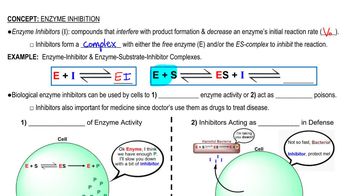
  • Enzyme Inhibition

    Cellular process where compounds decrease the initial velocity of enzyme-catalyzed reactions, affecting product formation.
  • Enzyme Inhibitor

    Specific compound that interferes with product formation, slowing or halting enzyme activity in biological systems.
  • Initial Reaction Velocity

    Rate at which an enzyme catalyzes a reaction before any significant product accumulates or inhibition occurs.
  • Free Enzyme

    Catalytic protein not bound to substrate, available for interaction with inhibitors or substrate molecules.
  • Enzyme-Substrate Complex

    Temporary molecular assembly formed when an enzyme binds its substrate, enabling catalysis or inhibition.
  • EI Complex

    Molecular structure resulting from an inhibitor binding to a free enzyme, preventing substrate interaction.
  • ESI Complex

    Assembly formed when an inhibitor binds to the enzyme-substrate complex, blocking further reaction progress.
  • Irreversible Inhibitor

    Compound that permanently disables enzyme activity, often referred to as an inactivator in biochemical contexts.
  • Reversible Inhibitor

    Compound that temporarily reduces enzyme activity, allowing normal function to resume once removed.
  • Competitive Inhibitor

    Molecule that competes with substrate for enzyme binding, affecting reaction rate by blocking active sites.
  • Uncompetitive Inhibitor

    Compound that binds only to the enzyme-substrate complex, altering reaction dynamics and reducing velocity.
  • Mixed Inhibitor

    Inhibitor capable of binding both free enzyme and enzyme-substrate complex, impacting reaction in multiple ways.
  • Noncompetitive Inhibitor

    Compound that binds to an enzyme regardless of substrate presence, decreasing activity without direct competition.
  • Regulation

    Cellular mechanism using inhibitors to control enzyme activity, maintaining proper product levels and metabolic balance.
  • Defense Mechanism

    Biological strategy where inhibitors act as poisons to protect cells from pathogens or harmful organisms.