Back

Fatty Acid Oxidation 1 definitions

Control buttons has been changed to "navigation" mode.
1/15
  • Fatty Acid

    Hydrocarbon chains stored in fats, broken down for energy and water, especially in desert-adapted organisms.
  • Glycerol

    Three-carbon molecule from fat breakdown, converted to glycolysis intermediates, yielding ATP and NADH.
  • Acetyl CoA

    Two-carbon molecule produced from fatty acid beta oxidation, enters the citric acid cycle for energy production.
  • Beta Oxidation

    Four-step mitochondrial process removing two-carbon units from fatty acids, generating Acetyl CoA.
  • Fatty Acyl CoA

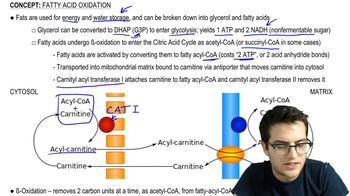
    Activated fatty acid bound to coenzyme A, required for mitochondrial transport and subsequent oxidation.
  • Carnitine

    Molecule shuttling fatty acyl groups into mitochondria, not consumed during transport, enabling beta oxidation.
  • Carnitine Acyltransferase 1

    Enzyme catalyzing attachment of fatty acyl CoA to carnitine, facilitating entry into mitochondria.
  • Carnitine Acyltransferase 2

    Enzyme releasing fatty acyl CoA from carnitine inside mitochondria, completing the carnitine shuttle.
  • Mitochondrial Matrix

    Intracellular compartment where beta oxidation occurs, processing fatty acids for energy.
  • Thiolase

    Enzyme cleaving fatty acyl CoA, releasing Acetyl CoA and preparing the molecule for another oxidation cycle.
  • FADH2

    Reduced electron carrier generated during the first step of beta oxidation, analogous to succinate dehydrogenase activity.
  • NADH

    Electron carrier produced during oxidation of alcohol to carbonyl in beta oxidation, similar to malate dehydrogenase.
  • Enoyl CoA Hydratase

    Enzyme catalyzing hydration of a double bond in beta oxidation, forming an alcohol group.
  • Beta Hydroxy Acyl CoA Dehydrogenase

    Enzyme oxidizing alcohol to carbonyl in beta oxidation, generating NADH.
  • Citric Acid Cycle

    Metabolic pathway receiving Acetyl CoA from beta oxidation, central to cellular energy production.