Back

Gluconeogenesis 2 quiz

Control buttons has been changed to "navigation" mode.
1/15
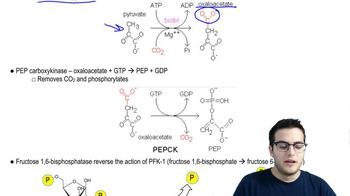
  • Which enzyme catalyzes the conversion of pyruvate to oxaloacetate in gluconeogenesis?

    Pyruvate carboxylase catalyzes this reaction, using ATP and adding a CO2 to pyruvate.
  • What molecule is used as an energy source by pyruvate carboxylase during gluconeogenesis?

    ATP is used as the energy source by pyruvate carboxylase.
  • Which enzyme converts oxaloacetate to phosphoenolpyruvate (PEP) in gluconeogenesis?

    PEP carboxykinase catalyzes the conversion of oxaloacetate to PEP, using GTP and releasing CO2.
  • Why does reversing the pyruvate kinase reaction in gluconeogenesis require two steps?

    The pyruvate kinase reaction is highly favorable and cannot be reversed in one step, so two enzymes and two nucleotide triphosphates are needed.
  • What is the role of fructose 1,6-bisphosphatase in gluconeogenesis?

    Fructose 1,6-bisphosphatase removes a phosphate from fructose 1,6-bisphosphate to produce fructose 6-phosphate, reversing PFK1's action.
  • Which enzyme removes the phosphate group from glucose 6-phosphate to produce glucose?

    Glucose 6-phosphatase removes the phosphate group from glucose 6-phosphate, yielding glucose.
  • In which organ is glucose 6-phosphatase primarily found?

    Glucose 6-phosphatase is primarily found in the liver.
  • What is the significance of gluconeogenesis in the body?

    Gluconeogenesis is crucial for maintaining blood sugar levels, especially during fasting.
  • Which glycolytic reactions are reversed by gluconeogenesis-specific enzymes?

    Gluconeogenesis reverses reactions 10, 3, and 1 of glycolysis using four specific enzymes.
  • What happens to the CO2 added to pyruvate during the first step of gluconeogenesis?

    The CO2 added to pyruvate is removed in the next step when oxaloacetate is converted to PEP.
  • Which nucleotide triphosphates are consumed in the conversion of pyruvate to PEP?

    ATP is consumed by pyruvate carboxylase and GTP is consumed by PEP carboxykinase.
  • What is the importance of oxaloacetate in gluconeogenesis?

    Oxaloacetate is an intermediate formed from pyruvate and is converted to PEP, linking gluconeogenesis to the citric acid cycle.
  • Which enzyme in glycolysis does fructose 1,6-bisphosphatase counteract?

    Fructose 1,6-bisphosphatase counteracts phosphofructokinase-1 (PFK1).
  • Why is glucose 6-phosphatase not found in muscle cells?

    Glucose 6-phosphatase is not found in muscle cells because gluconeogenesis mainly occurs in the liver, which maintains blood glucose for the body.
  • What is the final product of gluconeogenesis that can be released into the bloodstream?

    The final product is glucose, which can be released by the liver into the bloodstream.