Back

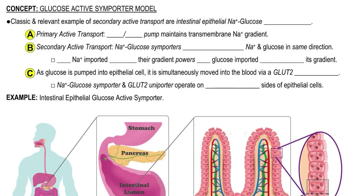
Glucose Active Symporter Model definitions

Control buttons has been changed to "navigation" mode.
1/15
  • Secondary Active Transport

    Cellular process where movement of one molecule is powered by the gradient established by primary active transport, not direct ATP hydrolysis.
  • Intestinal Epithelial Cell

    Specialized cell lining the intestine, responsible for absorbing nutrients and forming a barrier between the lumen and bloodstream.
  • Sodium-Glucose Symporter

    Membrane protein that co-transports sodium and glucose into cells, utilizing the sodium gradient for glucose uptake against its gradient.
  • Sodium-Potassium Pump

    Transmembrane protein that uses ATP to move sodium out and potassium into cells, creating a sodium gradient essential for nutrient absorption.
  • Concentration Gradient

    Difference in solute concentration across a membrane, driving passive or facilitated movement of molecules.
  • Intestinal Lumen

    Inner cavity of the intestine where digestion occurs and nutrients are available for absorption.
  • Villi

    Finger-like projections lining the intestinal wall, increasing surface area to enhance nutrient absorption.
  • Microvilli

    Tiny extensions on epithelial cells, further amplifying surface area for efficient absorption of nutrients.
  • GLUT 2 Uniporter

    Transport protein facilitating glucose movement in one direction across the cell membrane into the bloodstream.
  • Bloodstream

    Network of blood vessels closely associated with villi, enabling absorbed nutrients to circulate throughout the body.
  • ATP

    Molecule providing energy for cellular processes, such as the sodium-potassium pump, but not directly for sodium-glucose symporters.
  • Transmembrane Gradient

    Unequal distribution of ions across a cell membrane, crucial for driving secondary active transport mechanisms.
  • Uniporter

    Transport protein moving a single type of molecule in one direction across a membrane.
  • Primary Active Transport

    Cellular mechanism using ATP to move ions against their gradient, establishing conditions for secondary transport.
  • Absorption

    Process by which nutrients pass from the intestinal lumen into epithelial cells and then into the bloodstream.