Back

Glucose Active Symporter Model quiz

Control buttons has been changed to "navigation" mode.
1/15
  • What is the main function of the sodium-potassium pump in intestinal epithelial cells?

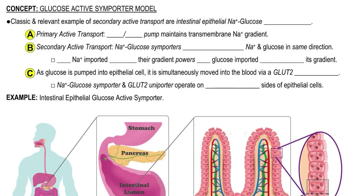
    The sodium-potassium pump creates a sodium gradient by transporting sodium out of the cell and potassium into the cell, using ATP.
  • How does the sodium-glucose symporter utilize the sodium gradient?

    It uses the energy from sodium moving down its concentration gradient to co-transport glucose into the cell against its concentration gradient.
  • What type of transport is the sodium-glucose symporter an example of?

    It is an example of secondary active transport.
  • Where are the sodium-glucose symporters located in the intestinal epithelial cells?

    They are located on the side of the cell facing the intestinal tract (lumen).
  • What is the role of the GLUT 2 uniporter in glucose absorption?

    The GLUT 2 uniporter transports glucose from the epithelial cell into the bloodstream in one direction.
  • Why is the sodium-glucose symporter considered a symporter?

    Because it transports both sodium and glucose in the same direction across the membrane.
  • Does the sodium-glucose symporter directly use ATP for transport?

    No, it does not use ATP directly; it relies on the sodium gradient established by the sodium-potassium pump.
  • What anatomical structures increase the surface area for absorption in the intestine?

    Villi and microvilli increase the surface area for absorption.
  • How many sodium ions are transported by the sodium-potassium pump per cycle?

    Three sodium ions are transported out of the cell per cycle.
  • How many potassium ions are transported into the cell by the sodium-potassium pump per cycle?

    Two potassium ions are transported into the cell per cycle.
  • What drives the movement of glucose into the intestinal epithelial cell?

    The movement of sodium down its concentration gradient powers the transport of glucose against its gradient.
  • On which side of the epithelial cell does the GLUT 2 uniporter operate?

    It operates on the side of the cell facing the bloodstream.
  • What happens to glucose after it enters the bloodstream from the epithelial cell?

    Glucose can diffuse to nearly every cell in the body.
  • What is the main difference between the sodium-glucose symporter and the GLUT 2 uniporter?

    The sodium-glucose symporter co-transports sodium and glucose into the cell, while the GLUT 2 uniporter transports only glucose out of the cell.
  • Why is the sodium-glucose symporter model important for nutrient absorption?

    It allows efficient absorption of glucose from the intestinal tract into the blood, even against a concentration gradient.