Back

Glycogen Metabolism 2 quiz

Control buttons has been changed to "navigation" mode.
1/15
  • What enzyme is responsible for breaking down glycogen to release glucose subunits?

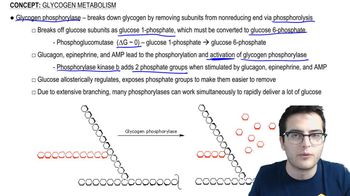
    Glycogen phosphorylase is responsible for breaking down glycogen by removing glucose subunits.
  • From which end of the glycogen molecule does glycogen phosphorylase remove glucose units?

    Glycogen phosphorylase removes glucose units from the non-reducing end of the glycogen molecule.
  • What is the product released by glycogen phosphorylase when it cleaves glycogen?

    Glycogen phosphorylase releases glucose 1-phosphate as the product when it cleaves glycogen.
  • Which enzyme converts glucose 1-phosphate to glucose 6-phosphate during glycogenolysis?

    Phosphoglucomutase converts glucose 1-phosphate to glucose 6-phosphate.
  • How is glycogen phosphorylase activated?

    Glycogen phosphorylase is activated by phosphorylation, specifically when two phosphate groups are added.
  • How is glycogen synthase regulated compared to glycogen phosphorylase?

    Glycogen synthase is activated when dephosphorylated, which is the opposite of glycogen phosphorylase.
  • Why is it important that glycogen phosphorylase and glycogen synthase are regulated in opposite ways?

    This regulation prevents both enzymes from being active at the same time, avoiding futile cycles in metabolism.
  • What effect does high blood glucose have on insulin and glycogen metabolism?

    High blood glucose increases insulin, which reduces glycogen breakdown and promotes glycogen synthesis.
  • What hormone is released during low blood glucose, and what is its effect on glycogen?

    Glucagon is released during low blood glucose, stimulating glycogen breakdown and reducing glycogen synthesis.
  • What is the role of the debranching enzyme in glycogenolysis?

    The debranching enzyme transfers three sugar units from a branch to a straight chain and releases a free glucose molecule.
  • What is unique about the glucose released by the debranching enzyme compared to other glucose units in glycogenolysis?

    The debranching enzyme releases one free glucose molecule, while all other glucose units are released as glucose 1-phosphate.
  • How does glucose allosterically regulate glycogen phosphorylase?

    Glucose exposes the phosphate groups on glycogen phosphorylase, making it easier to remove them and thus inactivating the enzyme.
  • Why can glycogen be rapidly mobilized in the body?

    Glycogen has many non-reducing ends, allowing multiple glycogen phosphorylase enzymes to work simultaneously and quickly release glucose.
  • What is the significance of preventing futile cycles in glycogen metabolism?

    Preventing futile cycles ensures that energy is not wasted by having synthesis and breakdown occur at the same time.
  • Which signaling molecules stimulate the phosphorylation and activation of glycogen phosphorylase?

    Glucagon, epinephrine, and AMP stimulate the phosphorylation and activation of glycogen phosphorylase.