Back

Glycogen Phosphorylase definitions

Control buttons has been changed to "navigation" mode.
1/15
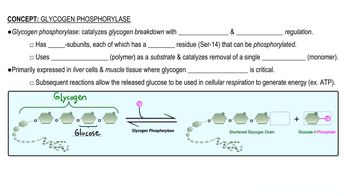
  • Glycogen

    A branched polymer composed of glucose monomers, serving as a storage form of energy in cells.
  • Glucose 1-phosphate

    A phosphorylated glucose molecule released from glycogen, used in cellular respiration for ATP production.
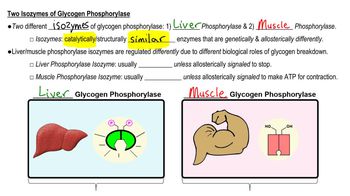
  • Isozyme

    A variant of an enzyme with similar catalytic function but distinct regulatory and genetic properties.
  • Liver Phosphorylase

    An isozyme predominantly active in liver cells, facilitating glycogen breakdown for blood glucose maintenance.
  • Muscle Phosphorylase

    An isozyme mainly inactive in muscle tissue, activated during muscle contraction to supply energy.
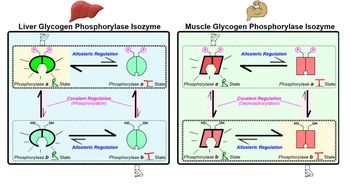
  • Phosphorylase a

    The catalytically active form of glycogen phosphorylase, characterized by phosphorylated serine residues.
  • Phosphorylase b

    The less active form of glycogen phosphorylase, distinguished by unphosphorylated serine residues.
  • Covalent Regulation

    A control mechanism involving chemical modification, such as phosphorylation, to alter enzyme activity.
  • Allosteric Regulation

    A process where enzyme activity is modulated by molecules binding at sites other than the active site.
  • Serine Residue

    A specific amino acid within glycogen phosphorylase, targeted for phosphorylation to regulate activity.
  • Phosphorylation

    A post-translational modification involving the addition of a phosphate group, crucial for enzyme activation.
  • R State

    The relaxed conformation of glycogen phosphorylase, associated with higher catalytic activity.
  • T State

    The tense conformation of glycogen phosphorylase, linked to reduced catalytic activity.
  • Cellular Respiration

    A multi-step process utilizing glucose to generate ATP, the primary energy currency of cells.
  • ATP

    A molecule produced during cellular respiration, providing energy for cellular functions and muscle contraction.