Back

Glycolysis 4 definitions

Control buttons has been changed to "navigation" mode.
1/15
  • Enolase

    Catalyzes the reversible dehydration of 2-phosphoglycerate to phosphoenolpyruvate, with a delta G near zero.
  • Phosphoenolpyruvate

    A high-energy intermediate in glycolysis, formed from 2-phosphoglycerate and used to generate ATP.
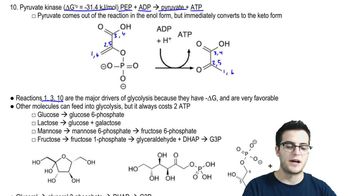
  • Pyruvate kinase

    Enzyme responsible for converting phosphoenolpyruvate to pyruvate, producing ATP in a highly favorable reaction.
  • Substrate-level phosphorylation

    Direct ATP generation in glycolysis, occurring when a phosphate group is transferred from a metabolic intermediate.
  • Delta G

    Represents the change in free energy for a reaction, indicating whether it is favorable or reversible.
  • Irreversible reaction

    A step in glycolysis with a highly negative delta G, ensuring the pathway proceeds in one direction.
  • Glucose 6-phosphate

    A phosphorylated glucose molecule that serves as the entry point for glycolysis and is produced from various substrates.
  • Glycerol

    A three-carbon molecule that can enter glycolysis, but produces excess NADH, limiting its use in anaerobic conditions.
  • NADH

    A reduced electron carrier generated during glycolysis, whose excess can hinder fermentation.
  • Glycogen phosphorylase

    Enzyme that breaks down glycogen into glucose 1-phosphate, enabling stored glucose to enter glycolysis.
  • Glucose 1-phosphate

    A product of glycogen breakdown that must be converted to glucose 6-phosphate before entering glycolysis.
  • Lactose

    A disaccharide that is split into glucose and galactose, both of which can feed into glycolysis.
  • Fructose 1-phosphate

    A phosphorylated fructose intermediate that is cleaved into glyceraldehyde and DHAP for glycolytic entry.
  • Glyceraldehyde 3-phosphate

    A glycolytic intermediate formed from various substrates, crucial for ATP and NADH production.
  • Dihydroxyacetone phosphate

    A glycolytic intermediate that can be converted to glyceraldehyde 3-phosphate, facilitating entry of alternative substrates.