Back

Heme Prosthetic Group definitions

Control buttons has been changed to "navigation" mode.
1/15
  • Heme

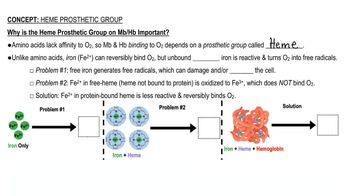
    Flat, disc-shaped structure composed of ferrous iron and protoporphyrin 9, enabling reversible oxygen binding in hemoglobin and myoglobin.
  • Prosthetic Group

    Non-protein component tightly integrated into a protein, essential for its biological function, such as oxygen binding in hemoglobin.
  • Myoglobin

    Oxygen-binding protein with a single subunit, utilizing a heme group for reversible oxygen interaction, lacking cooperative binding.
  • Hemoglobin

    Multisubunit oxygen transport protein, containing heme groups and exhibiting cooperative oxygen binding through conformational changes.
  • Ferrous Iron

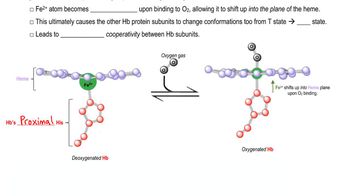
    Central iron ion in heme, in the Fe2+ oxidation state, responsible for reversible oxygen binding and avoiding free radical formation.
  • Protoporphyrin 9

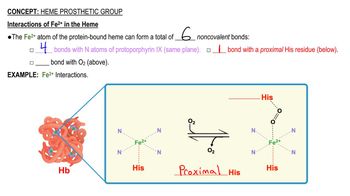
    Planar tetrapyrrole ring system surrounding iron in heme, providing structural support and facilitating non-covalent interactions.
  • Tetrapyrrole

    Ring system composed of four pyrrole rings, forming the backbone of protoporphyrin 9 in the heme structure.
  • Non-covalent Bond

    Interaction stabilizing heme within proteins, including hydrophobic, hydrogen, and ionic bonds, crucial for oxygen binding and protein structure.
  • Proximal Histidine

    Amino acid residue located below the heme plane, directly interacting with iron to stabilize its position within hemoglobin or myoglobin.
  • Distal Histidine

    Amino acid residue positioned above the heme plane, forming a hydrogen bond with bound oxygen to prevent iron oxidation and reduce CO toxicity.
  • Oxygen Affinity

    Capacity of hemoglobin or myoglobin to bind oxygen, determined by the heme group and influenced by protein conformation and interactions.
  • Ferric Iron

    Oxidized iron ion (Fe3+) in heme, unable to reversibly bind oxygen, often resulting from loss of stabilization by protein environment.
  • Carbon Monoxide

    Toxic molecule that binds heme iron more strongly than oxygen, blocking oxygen transport and causing cellular damage.
  • Positive Cooperativity

    Phenomenon in hemoglobin where oxygen binding to one subunit increases affinity in others, enhancing overall oxygen uptake.
  • Allosteric Protein

    Protein capable of conformational changes upon ligand binding, such as hemoglobin, enabling regulation of function and cooperative interactions.