Back

Heme Prosthetic Group quiz

Control buttons has been changed to "navigation" mode.
1/15
  • Why do myoglobin and hemoglobin require the heme prosthetic group to bind oxygen?

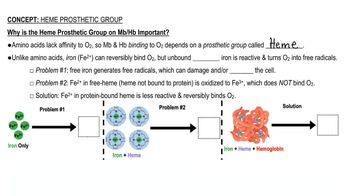
    Amino acids alone lack affinity for oxygen, so myoglobin and hemoglobin depend on the heme group, which contains iron capable of reversible oxygen binding.
  • What is the main structural feature of the heme prosthetic group?

    The heme group is a flat, planar, disc-shaped structure composed of a ferrous iron (Fe2+) atom at the center of a tetrapyrrole ring called protoporphyrin 9.
  • Why can't free iron (Fe2+) alone be used for oxygen transport in cells?

    Free iron is highly reactive and can generate free radicals, which can damage or kill cells.
  • What problem arises if heme is not bound to a protein?

    Unbound heme is still reactive, and its iron can be oxidized to Fe3+, which cannot reversibly bind oxygen.
  • How does protein-bound heme solve the issues of free iron and free heme?

    Protein-bound heme keeps iron in the Fe2+ state, reducing reactivity and preventing free radical formation, thus allowing reversible oxygen binding.
  • What is the chemical name for the ring system in the heme group?

    The ring system is called protoporphyrin 9, a planar tetrapyrrole ring.
  • How is the heme group attached to myoglobin and hemoglobin?

    The heme group is attached mainly via non-covalent interactions, especially hydrophobic interactions with non-polar amino acids.
  • How many non-covalent bonds does the iron atom in heme form, and with what?

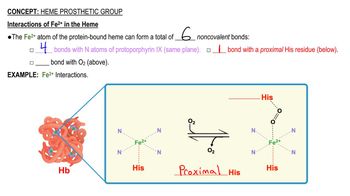
    The iron atom forms six non-covalent bonds: four with nitrogen atoms of protoporphyrin 9, one with a proximal histidine residue, and one with an oxygen molecule (when oxygen is bound).
  • What is the role of the proximal histidine in the heme group?

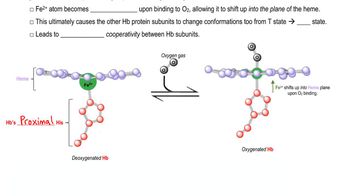
    The proximal histidine forms a non-covalent bond with the iron atom below the plane of the heme, helping to anchor the iron within the protein.
  • What is the function of the distal histidine in hemoglobin and myoglobin?

    The distal histidine stabilizes the bound oxygen via a hydrogen bond and helps prevent oxidation of Fe2+ to Fe3+.
  • Why is carbon monoxide (CO) so toxic in relation to the heme group?

    CO binds to the iron in heme much more strongly than oxygen, outcompeting oxygen and blocking its binding site.
  • How does the distal histidine affect carbon monoxide toxicity?

    The distal histidine reduces CO's ability to bind to the heme group, making CO less toxic.
  • What conformational change occurs in hemoglobin when oxygen binds to the heme group?

    Oxygen binding causes the iron atom to move into the plane of the heme, triggering a conformational change in hemoglobin from the T (tense) state to the R (relaxed) state.
  • What is positive cooperativity in hemoglobin, and how is it related to the heme group?

    Positive cooperativity means that oxygen binding to one heme group increases the affinity of other subunits for oxygen, due to conformational changes in hemoglobin.
  • Why does myoglobin not display cooperativity like hemoglobin?

    Myoglobin has only one subunit, so it cannot exhibit cooperative binding; only hemoglobin, with multiple subunits, shows this property.