Back

Hill Equation quiz

Control buttons has been changed to "navigation" mode.
1/15
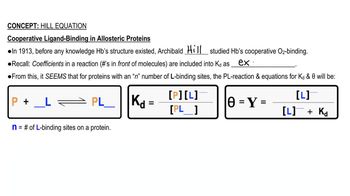
  • Who introduced the Hill Equation and in what year?

    Archibald Hill introduced the Hill Equation in 1913.
  • What does the Hill Equation describe in biochemistry?

    The Hill Equation describes cooperative ligand binding in allosteric proteins, such as hemoglobin.
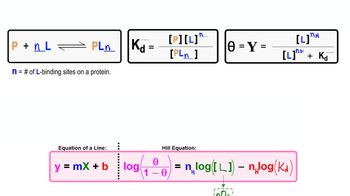
  • What is the Hill constant (n_h) and what does it represent?

    The Hill constant (n_h) is also called the Hill coefficient and represents the degree of cooperativity in ligand binding.
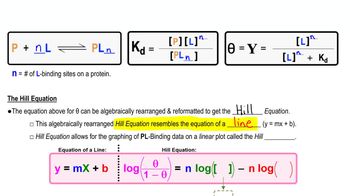
  • How does the Hill Equation resemble the equation of a line?

    The Hill Equation can be rearranged to resemble y = mx + b, making it easier to interpret binding data.
  • What is the range of possible values for the Hill constant (n_h)?

    The Hill constant n_h ranges from 0 to the number of ligand binding sites (n) on a protein.
  • What does it mean if the Hill constant n_h equals 1?

    If n_h equals 1, there is no cooperativity in ligand binding.
  • What does a Hill constant n_h greater than 1 indicate?

    A Hill constant n_h greater than 1 indicates positive cooperativity in ligand binding.
  • What does a Hill constant n_h less than 1 indicate?

    A Hill constant n_h less than 1 indicates negative cooperativity in ligand binding.
  • How is the dissociation equilibrium constant (k_d) affected in the Hill Equation?

    In the Hill Equation, k_d is raised to the power of n_h to account for cooperativity.
  • What is the typical value of hemoglobin's Hill constant (n_h), and how many binding sites does it have?

    Hemoglobin's Hill constant n_h is about 3, even though it has 4 ligand binding sites.
  • What does the Hill plot allow scientists to do?

    The Hill plot allows scientists to graph protein-ligand binding data in a linear form for easier analysis.
  • When does the Hill constant n_h equal the number of ligand binding sites n?

    n_h equals n when there is no cooperativity or when the protein follows only the concerted model of cooperativity.
  • What models explain hemoglobin's oxygen binding behavior?

    Hemoglobin's oxygen binding behavior is explained by a combination of the concerted and sequential models.
  • How do you calculate fractional saturation (θ) using the Hill Equation for hemoglobin?

    Fractional saturation θ is calculated as [L]^n_h / ([L]^n_h + k_d^n_h), where [L] is ligand concentration and n_h is the Hill constant.
  • What does a Hill constant n_h of 3 for hemoglobin indicate about its binding behavior?

    A Hill constant n_h of 3 for hemoglobin indicates significant positive cooperativity, but not the maximum possible for its four binding sites.