Back

Inhibition Constant quiz

Control buttons has been changed to "navigation" mode.
1/15
  • What does the inhibition constant (KI) represent in enzyme inhibition?

    KI represents the dissociation constant for the enzyme-inhibitor complex (EI) and indicates the binding affinity between enzyme and inhibitor.
  • How is the rate constant for the formation of the enzyme-inhibitor complex denoted?

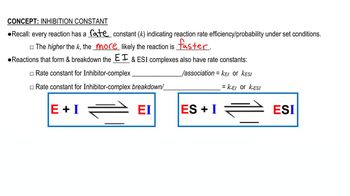
    The rate constant for formation is denoted as KEI.
  • What does the minus sign in k−EI or k−ESI indicate?

    The minus sign indicates the breakdown or dissociation of the enzyme-inhibitor (EI) or enzyme-substrate-inhibitor (ESI) complex.
  • Under what conditions is the inhibition constant (KI) derived?

    KI is derived under steady state conditions, where the concentration of the enzyme-inhibitor complex remains constant.
  • What is the relationship between KI and binding affinity?

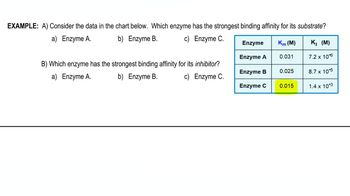
    KI has an inverse relationship with binding affinity; a lower KI means stronger binding between enzyme and inhibitor.
  • How is the inhibition constant for the enzyme-substrate complex denoted?

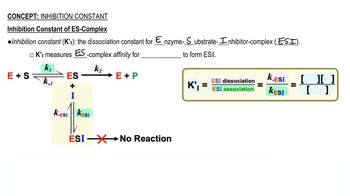
    It is denoted as K'I (K prime I), which measures the affinity of the enzyme-substrate-inhibitor complex (ESI).
  • What is the formula for KI in terms of rate constants?

    KI is the ratio of the EI dissociation rate constant (k−EI) over the EI association rate constant (KEI).
  • How does KI compare to the Michaelis constant (KM)?

    KI is very similar to KM, but KI measures enzyme-inhibitor affinity while KM measures enzyme-substrate affinity.
  • What does K'I measure?

    K'I measures the affinity of the enzyme-substrate complex for the inhibitor, forming the ESI complex.
  • What is the formula for K'I in terms of rate constants?

    K'I is the ratio of the ESI dissociation rate constant (k−ESI) over the ESI association rate constant (KESI).
  • What happens to the reaction when the inhibitor is bound to the enzyme or enzyme-substrate complex?

    When the inhibitor is bound, the reaction cannot proceed.
  • What is the significance of steady state conditions in deriving KI and K'I?

    Steady state conditions ensure that the formation and breakdown rates of EI or ESI complexes are equal, allowing derivation of KI and K'I.
  • How is the concentration-based formula for KI expressed?

    KI equals the concentration of free enzyme times free inhibitor divided by the concentration of the EI complex.
  • How is the concentration-based formula for K'I expressed?

    K'I equals the concentration of enzyme-substrate complex times free inhibitor divided by the concentration of the ESI complex.
  • What is the main difference between KI and K'I?

    KI measures the affinity of the free enzyme for the inhibitor, while K'I measures the affinity of the enzyme-substrate complex for the inhibitor.